
Above the Fold
Beginner’s Luck and A String of Firsts

“Above the fold” refers to the upper half of a newspaper’s front page, visible when the paper is folded for display on a newsstand and elsewhere.. It’s where editors place their most important headlines and eye-catching photographs to attract readers and sell copies.
Early in my sophomore year at USC, on a dreary morning before classes, my sole companion on campus was a Bronze Age—and in fact bronze—effigy: Tommy Trojan. He stood on a plinth in front of Bovard Auditorium, bare-chested, miniskirted, and plume-helmeted, lunging forward heroically with sword and shield in hand, ready to fend off UCLA undergrads intent on vandalism. I knew I could count on him to hold that pose while I practiced the picture-taking techniques I was still learning.
I shook a small aluminum canister from the yellow-and-green cardboard box in my pocket, unscrewed the cap, and dropped a roll of Tri-X into my left palm. With my right hand, I raised the plundered Pentax on its neck strap and popped its back open by pulling up on the tiny rewind crank with my left thumb and forefinger. The back swung open on a hinge, helped by a flick of my right wrist. I plopped in the cassette and slipped its narrow tongue of film into a slotted spool, aligned the sprocket holes, took up the slack with the film-advance lever, and snapped the camera shut. I thumbed the advance lever twice, which also cocked the shutter, and released it both times. Then I advanced the film one more time to frame Nº 1 and left the shutter cocked.
Ready.
As I leveled my lens at Tommy, a muffled racket intruded on my concentration. I turned to follow Tommy’s gaze toward Doheny Library across the quad, just in time to see a man burst out the door on the run. He was holding a knife. He tossed it. The racket rose to loud, urgent shouts as several people followed him in hot pursuit. I joined the chase, trying with one hand to hold the camera up to my eye while my other hand steadied the clarinet case slung over my shoulder, slapping against my hip.
I stopped, aimed, and focused through the viewfinder.
Click.
I began running again, holding the camera and winding the film with one hand.
Stop. Steady camera with both hands. Focus. Click. Wind film. Run.
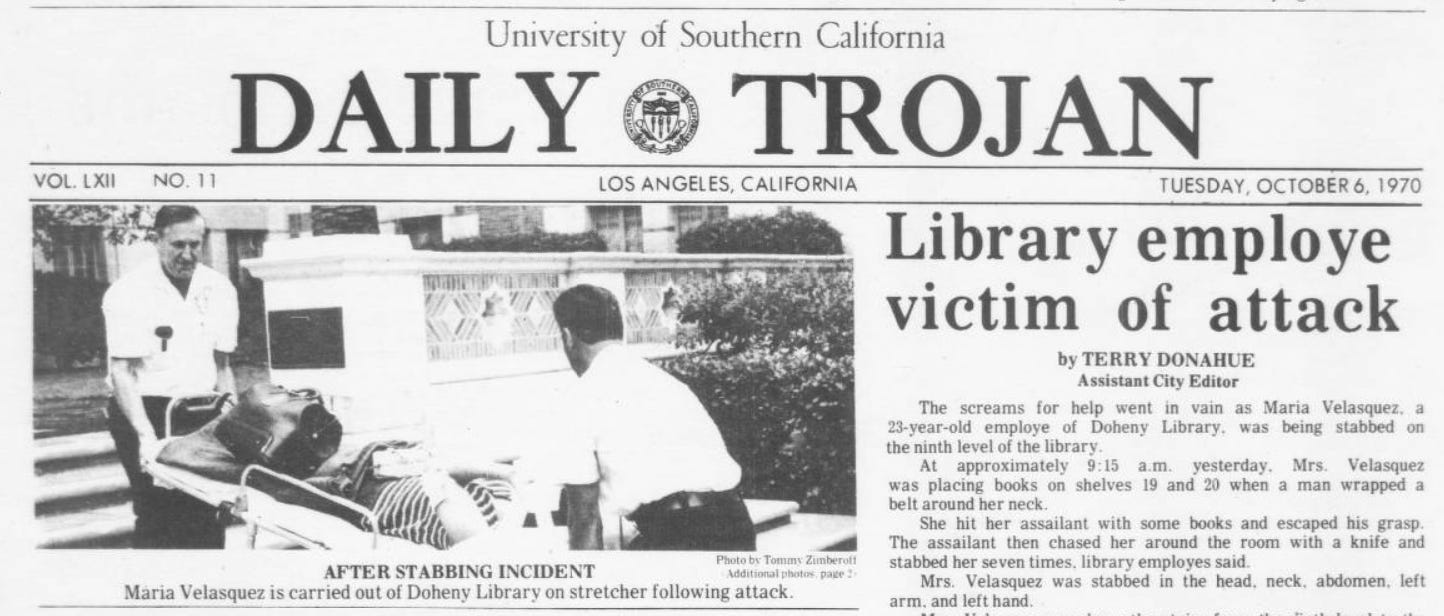
Our quarry holed up in a classroom a few hundred yards away. I learned that he had stabbed a woman—seven times. She lay critically wounded in the library’s basement stacks. When I heard sirens, I returned to the library in time to photograph her being carried out on a gurney to an ambulance.
She survived.
Bystanders were being shooed away by police when Tony Korody introduced himself to me. Tony was the student photo editor of the Daily Trojan, our school’s awkwardly named newspaper. He’d seen my camera and wanted to know if I’d gotten any of this on film. I handed him the roll of Tri-X and followed him to the DT darkroom to develop it. He was racing against a deadline, so we didn’t wait for the assailant’s arrest.
I got nothing usable during the chase. But my picture of the victim being carried out of the library made the front page. It was not a great photo, but I was in print.
First time!
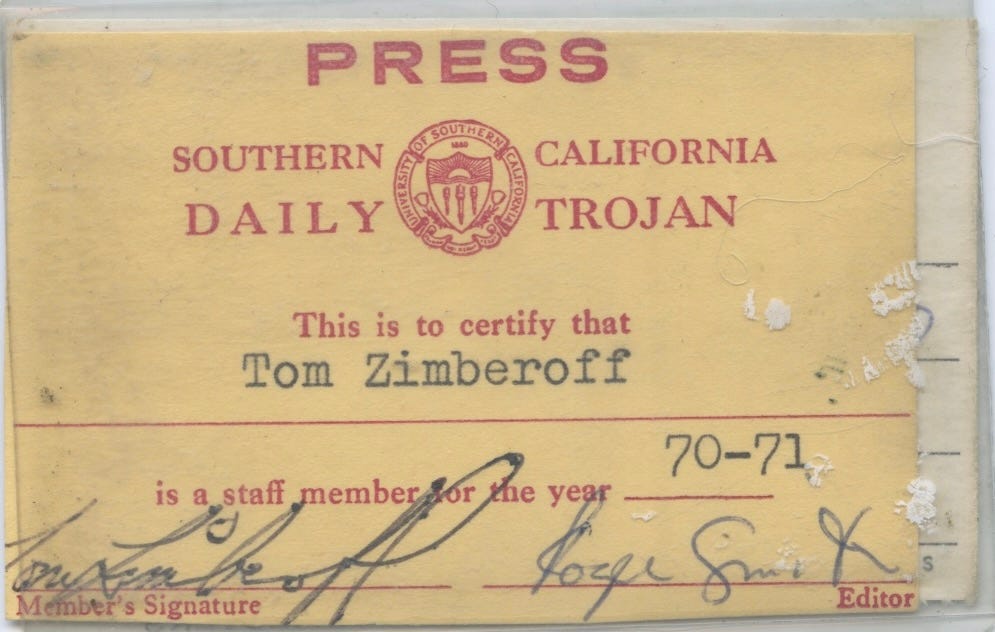
This was before my Leon Russell poster was published, although it was shot the previous year. (Again, that story is recounted in my previous post, “The Pivot.”) Tony offered me a slot on the paper, with darkroom privileges and all the film I could shoot.
The DT photographers were journalism majors. At USC, at least, no degree in photo-journalism—or any college degree specific to photography—was available in 1970. Tony’s earnestness, and that of Peter Read Miller, another photographer shooting for the school yearbook, was contagious. Through them I was introduced to the work of Gordon Parks, W. Eugene Smith, Henri Cartier-Bresson, Robert Capa, and Robert Frank, I began to appreciate photography’s social impact as well as its aesthetic appeal.
Peter informed my growing appreciation of sports photography by introducing me to the work of John Zimmerman, Walter Iooss, and Neil Leifer. I learned about color theory by looking at Pete Turner, Art Kane, Ernst Haas, and the landscapes of Eliot Porter. Then came Ansel Adams and the exquisite, reductionist drama of his black-and-white landscapes.
I visited galleries and museums, staring at framed prints for endless hours. I remained indecisive about what photographic genre appealed most to me until I encountered—and was captivated by—the portraiture of Philippe Halsman, Arnold Newman, Richard Avedon, Yousuf Karsh, Irving Penn, and, later, August Sander.
Looking at photographs in books and museums, inspiring as it was, could not teach me how to achieve the results I wanted. To become proficient with my new instrument, the camera, I had to learn certain fundamental rules and apply them by rote. I had to practice my scales, so to speak, just as I did with the clarinet. Once the neurons connecting my brain, breath, and fingers were synchronized through repetition, I would be free to break those rules.
That is what it means to earn a creative license.
I literally breathed through a clarinet and figuratively through a camera. The camera also breathed new life—a new way of seeing—into me.
At first, I was attracted less to making pictures than to owning a camera for its intrinsic qualities. It was such a wonderfully cool thing, almost a fashion accessory. But as I used it more, I came to understand that practicing photography did something for me, something that the merely possession of a camera could not. It cultivated a sense of wonder, a way of seeing details with intention, and the quiet joy of revealing—to others and sometimes to myself—what often goes unnoticed.
My clarinet études (written music exercises) had a photographic equivalent: the Life Library of Photography, all seventeen silver-and-black, 10¼-inch-square volumes. The series began publication in 1970 under the Time-Life Books imprint. I bought each volume, one after another, as I could afford them. I still have the full set. Each volume tackled a specific aspect of the art, science, and practice of photography. There was no single author. Contributors included Time-Life editors and some of the formidable photographers shooting for Life magazine.
For anyone compelled to transpose what their mind’s eye sees into a photograph, everything you need to know is in those books. Everything, that is, except how photography went digital. But the principles remain the same. Equally instructive and inspirational was Ansel Adams’s five-volume Basic Photo series, which began publication in 1948. The books are also available secondhand.
In addition to shooting photos for the DT with that puce Pentax, I brought it to every USC basketball and football game I was required to attend as a member of the Trojan Band as per the terms of my scholarship. Between marching in formation with my alto sax and belting out fight songs from the bleachers, I could occasionally move courtside or onto the sidelines and into the end zones at the Los Angeles Coliseum, learning on the fly how to photograph action sports.
Peter left USC early because his freelance sports work was already in demand; by 1983 he was on staff for Sports Illustrated. Tony scored his first Newsweek cover while he was still at USC. He left early, too, and did well freelancing, primarily for People. He also landed exclusive distribution rights to surveillance photos of kidnapped heiress Patty Hearst, the Stockholm-syndrome antihero herself, hefting an assault rifle in cahoots with the Symbionese Liberation Army during a bank robbery in San Francisco. Those pictures soon helped him launch his own photo agency, Fourth Estate Press.
I would leave USC before my junior year.
Before I made that decision, the USC cinema department introduced its first elective course in still photography. I inquired about switching my major from music to cinema—close enough to photography, I thought—but my scholarship made that impossible. I enrolled in the class anyway.
A few weeks in, we were given a weekend assignment: come up with a story idea, shoot it, process the film, make prints, and mount them on storyboards for show-and-tell on Monday.
That Saturday night, I was in the Daisy, Jack Hanson’s jet-set disco playing pool with another Beverly High alum, Steve March-Tormé, the son of jazz singer Mel “The Velvet Fog” Tormé. We were underage, but because we knew Jack’s son, Terry, the tuxedoed maître d’, Charlie Brown, let us in.
No rope line. Getting past the front door depended largely on Charlie’s sizing up your celebrity quotient and sartorial vibe, speakeasy style, glimpsed through a hinged Judas door: women in hot pants, men dressed like Jimi Hendrix. The Daisy was a magnet for high-society and the “beautiful people” of the sixties and seventies: models, actors, writers, artists, directors, musicians, and the merely rich. On any given night, it wasn’t unusual to spot Dean Martin, Raquel Welch, Mel Brooks, Jimmy Caan, or Richard Pryor.
Come last call, if comedian Joey Bishop was in the house, he’d grab a handful of young stragglers and walk us a block and a half down Rodeo Drive to MFK’s, the corner café inside the Beverly Wilshire Hotel, where he held court and told stories. Joey was one of the Las Vegas Rat Pack.
I once danced the Mashed Potato at the Daisy with Judith Jamison of the Alvin Ailey Dance Theater. I met Life photographer and film director Gordon Parks there. Rarely did the women who frequented the club not need a headshot or, often enough, express an eagerness to memorialize their beauty and youth by posing nude.
Just past Charlie and the front door was the billiard room. I was racking balls for Steve to break when Max Baer, Jr. burst in—Jethro Clampett from The Beverly Hillbillies—yelling for help.
That was surely life imitating art.
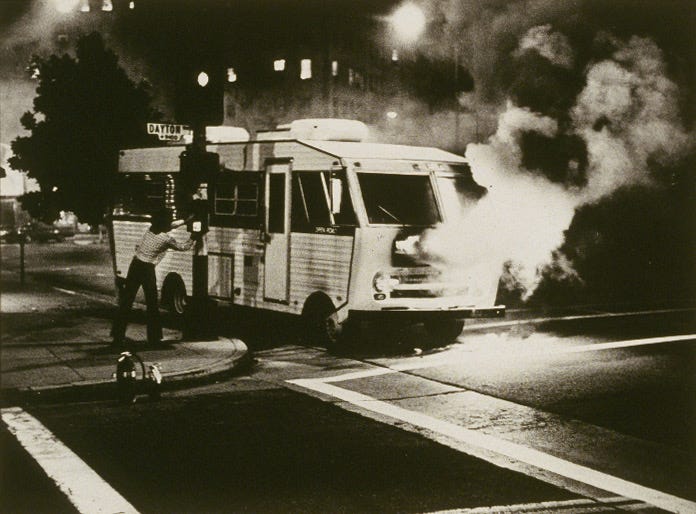
Baer’s motor home, still something of a novelty in 1971, had caught fire outside the club’s front door. Flames leapt from the engine grille. Baer had bailed out but left the vehicle in neutral without pulling the handbrake. It rolled backward onto the curb and stopped at the intersection of Dayton Way and Rodeo Drive, next to an ornate stanchion: a lamppost supporting street signs, traffic lights, and an old-fashioned fire alarm box. Break glass and pull.
Steve grabbed a fire extinguisher off the wall near the Daisy’s kitchen while I made a beeline for my borrowed ride. Hunkering in the parking lot next door was my sister Dede’s incredibly cool 1962 Cadillac Coupe de Ville convertible, shiny black with abbreviated fins. I unlocked the glove box and grabbed my Pentax.
