
The Lost Weekend
Not my lost weekend, John Lennon's. He was having a hard day's night.

Starting out, one spends more time pitching portfolios than shooting assignments, enduring the astringent indifference to one’s hard work and aspirations by those being pitched. Show-and-tell invariably ends with “Don’t call us; we’ll call you.” Nevertheless, with the indefatigable drive of a twenty-one-year-old, newly responsible for paying rent on his first grown-up apartment, and already a self-professed pro photographer for two years, I called Crawdaddy.
Crawdaddy was the first magazine to insist that popular music deserved to be taken as seriously as literature, politics, and fine art. Crawdaddy cut the groove before Rolling Stone dropped the needle.
Crawdaddy had just opened a Los Angeles bureau. Perfect timing.
All I had to show was what I’d done with bands performing live onstage: rock ’n’ roll after roll of black-and-white and color film. My presentation was not sophisticated: 35mm color slides arrayed in loose-leaf polypropylene pages in a three-ring binder and some black-and-white prints sleeved in acetate pages collated in a leather carrying case. But perhaps because I was one of the first photographers—maybe the very first—to cold-call and be invited to visit their new L.A. digs, the editor who took the meeting, Patrick Snyder, called me back just two days later with an assignment.
Snyder, who preferred to be called by his nickname, Scumpy, gave me a date and time to meet him at an address in the hoity-toity West L.A. enclave of Bel-Air. I was going to accompany him on an interview with— drum roll, please—John Lennon.
In the summer of 1973, at the age of thirty-two, Lennon fell into an abyss of self-destructive behavior marked by philandering and excessive drinking. Contrary to popular belief at the time, his troubles had little to do with The Beatles’ breakup three years earlier. They seem instead to have grown out of a deeper emotional unraveling, one Lennon may have glimpsed years earlier when he cried out for “Help!”—and were deepened by the relentless efforts of the United States government to deport him.
The government’s pretext was Lennon’s 1968 arrest in London for hashish possession. Really, it was about politics. The Nixon administration, enraged by Lennon’s anti-Vietnam War activism, orchestrated a campaign to terrorize him, his friends, and associates by having them tailed wherever they went and tapping their phones. The surveillance was meant to be obvious; the G-men brazenly let themselves be seen, and the telltale clicks of wiretaps were a dead giveaway. Lennon sank under the weight of this sustained psychological assault. When he hit bottom, so did his marriage to Yoko Ono.
Yoko, a loving but canny agent provocateur, apparently saved their relationship by pushing John away for the time being. She insisted he leave New York for Los Angeles and take May Pang, their amenable and already romantically implicated amanuensis with him. The summer stretched into a year and a half of debauchery, bizarre recording sessions, and ultimately an exorcism of the demons inhabiting John’s head. It has come to be known pithily as The Lost Weekend. Thursday, November 15, 1973, was smack in the heart of it.
Lennon himself answered my nine-o’clock knock on the door that morning, still full as a tick. “Good morning,” he said. “You must be Tom.”
That Liverpudlian lingo! Those round, wire-rimmed glasses! I tried not to act starstruck when I stuck out my hand. But I was thinking: Wow! John Lennon knows my name.
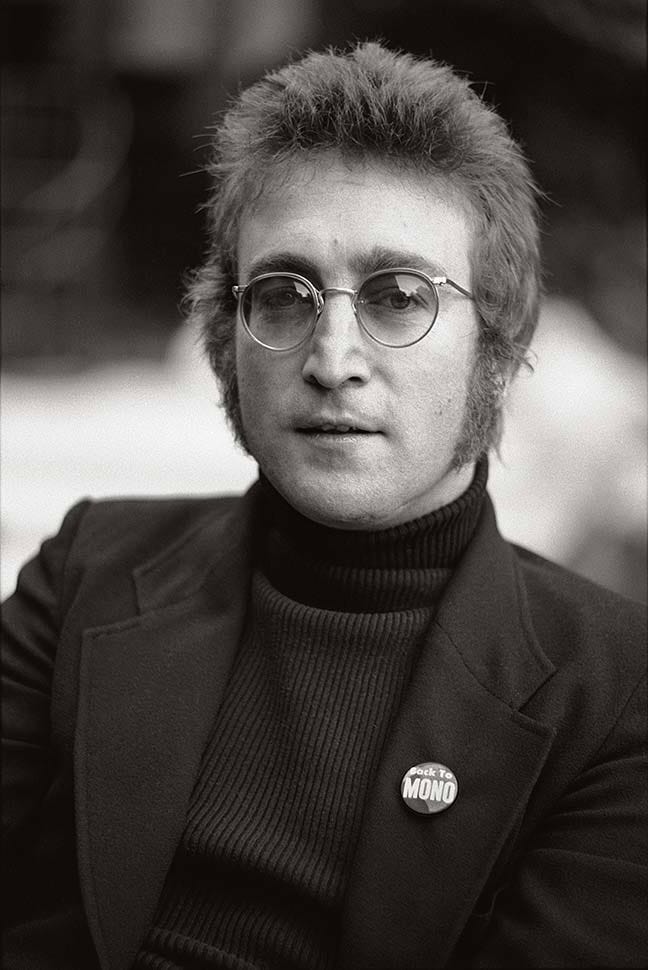
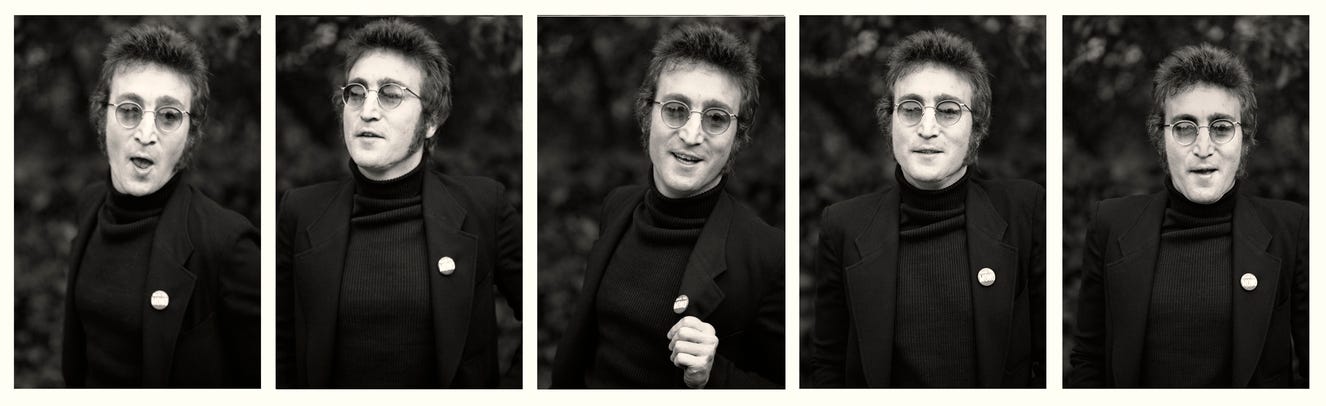
I expected to see one familiar likeness or another of John the Beatle; you know, from the pictures we’ve all seen, having morphed from mop-top to hirsute hippie. Instead, I was startled to see that his locks were shorn to a bristle brush with abbreviated mutton chop sideburns.
It wasn’t a look that would last. This detail matters because, aside from May Pang’s photos, mine are among the very few made during Lennon’s eight-dollar-haircut days, giving them the stamp of The Lost Weekend.
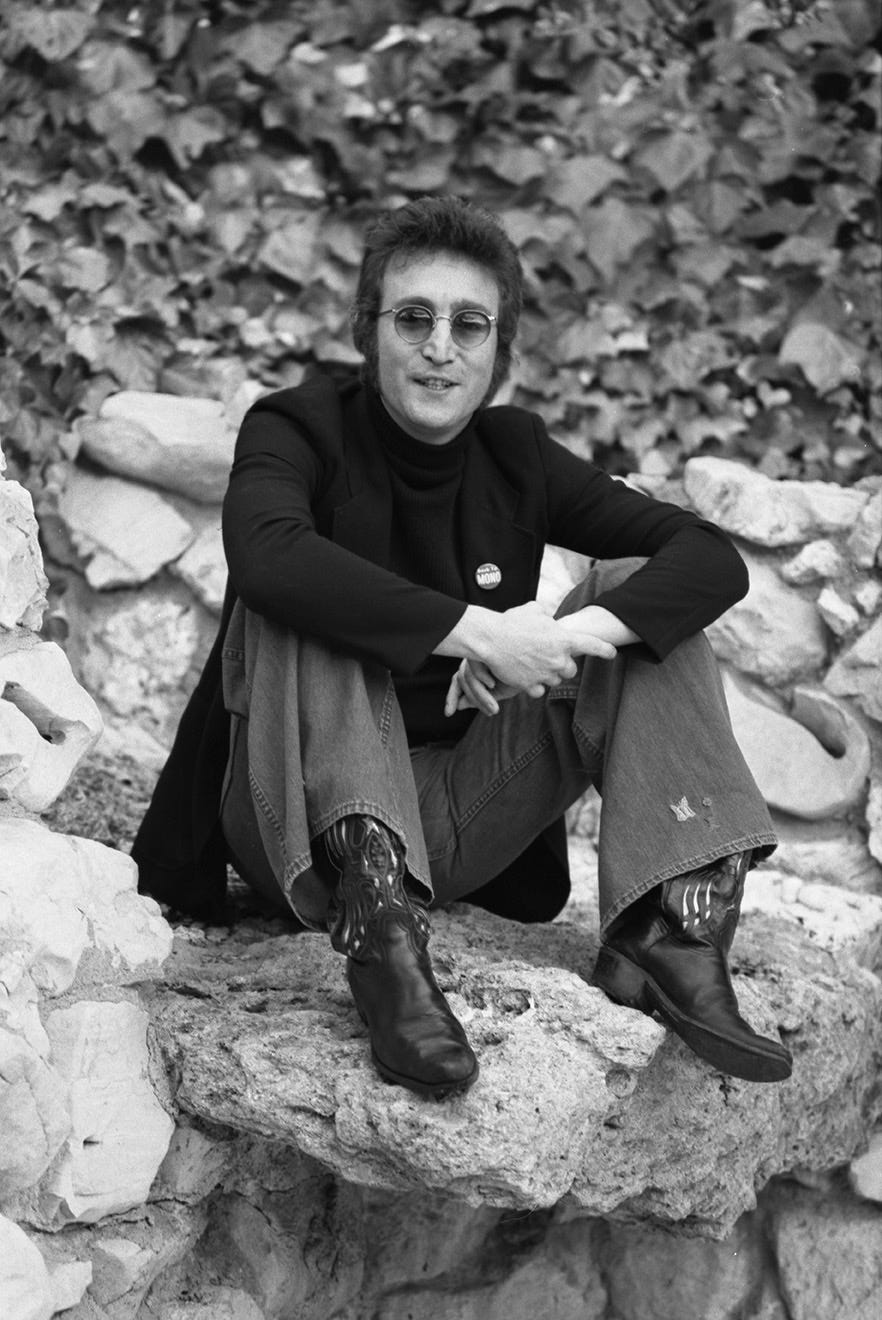
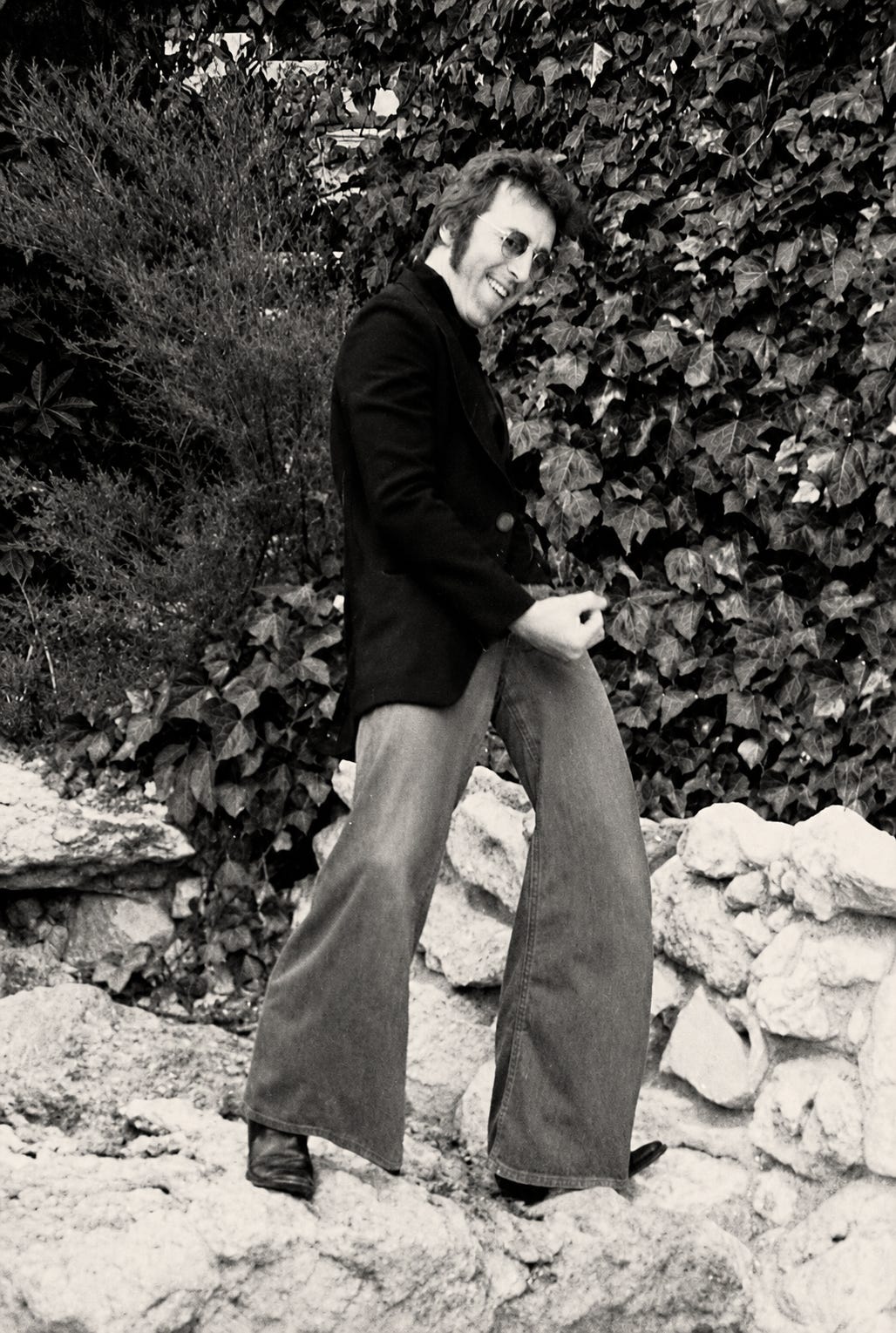
John was not much shorter than my six feet, but he wore colorfully stitched cowboy boots with heels that gave him an extra inch. He also wore a black cashmere sport coat over a knitted black turtleneck sweater and bell-bottom blue jeans with florets and butterflies appliquéd near the hem of each leg.
The musicians with whom John had obviously stayed up all night had all just taken off but one: Native-American guitar wizard Jesse Ed Davis was on his way out the door as I came in. We were in the home of legendary record producer Lou Adler, who rented the place to Lennon. Adler recorded Carole King, Jan & Dean, The Mamas & the Papas, and helped create The Rocky Horror Picture Show.
With this assignment, I wanted to create something special, something I had yet to try: a deliberate portrait. It would be pre-visualized and carefully composed, more substantive than a candid photo. A portrait would strive for artistic merit and also indicate a level of collaboration with Lennon.
Since my initiation at the USC Daily Trojan, when I first became acquainted with the portraiture of Penn, Karsh, and Halsman et al., I wanted to try my hand—my eye—at portraiture. But I was holding out for a medium- or large-format camera like the ones my heroes used for really sharp, grainless, detail-rich images. My only tools so far were two Nikon bodies, my Leon Russell Leica, and five lenses—all 35mm.
I planned to compensate for the “miniature” roll-film negatives that 35mm cameras produce by shooting extremely high-resolution black-and-white film: Kodak Panatomic-X would let me wring as much detail as possible from a small negative. But high-resolution film—what we called “slow” film—required longer exposures, so I brought a tripod, useful not only for stability but for composing with care and then locking it within my frame.
While Yoko remained in New York, and despite John’s copious consumption of alcohol, he was recording prodigiously: covers of early rock ’n’ roll standards by Jerry Lee Lewis, Chuck Berry, Carl Perkins, Little Richard, Elvis Presley, Fats Domino ... all of the artists who had inspired him as a teenager in Liverpool. Jesse Ed Davis and “Put the Lime in the Coconut” songwriter Harry Nilsson regularly joined Lennon to jam at the Bel-Air house and recorded with him at A&M Studios in Hollywood. So did Ringo Starr, Keith Moon, and Leon Russell. I heard that McCartney paid him a visit at the house in Bel-Air.
Lennon’s L.A. studio tracks were produced by Phil Spector, while, at the same time, Spector was compiling an album of hits from his own “Da Do Ron Ron” Wall of Sound days. The project was called Back to Mono, which accounts for the rubric on John’s lapel pin, visible in my photographs. The sessions quickly passed into legend for their chaos, much of it fueled by alcohol, strong personalities, and Spector’s own deranged theatrics.
Scumpy arrived shortly after I did, accompanied by a freelance writer named Jack Breschard. John pulled himself together nicely for the interview, considering how many empty bottles were strewn throughout the house, evidence of the previous night’s jam session. Spliffs were lined up on a coffee table next to a note reminding John to “[buy] jeans for Julian,” scribbled in broad strokes with a Sharpie on the back of a catalog.
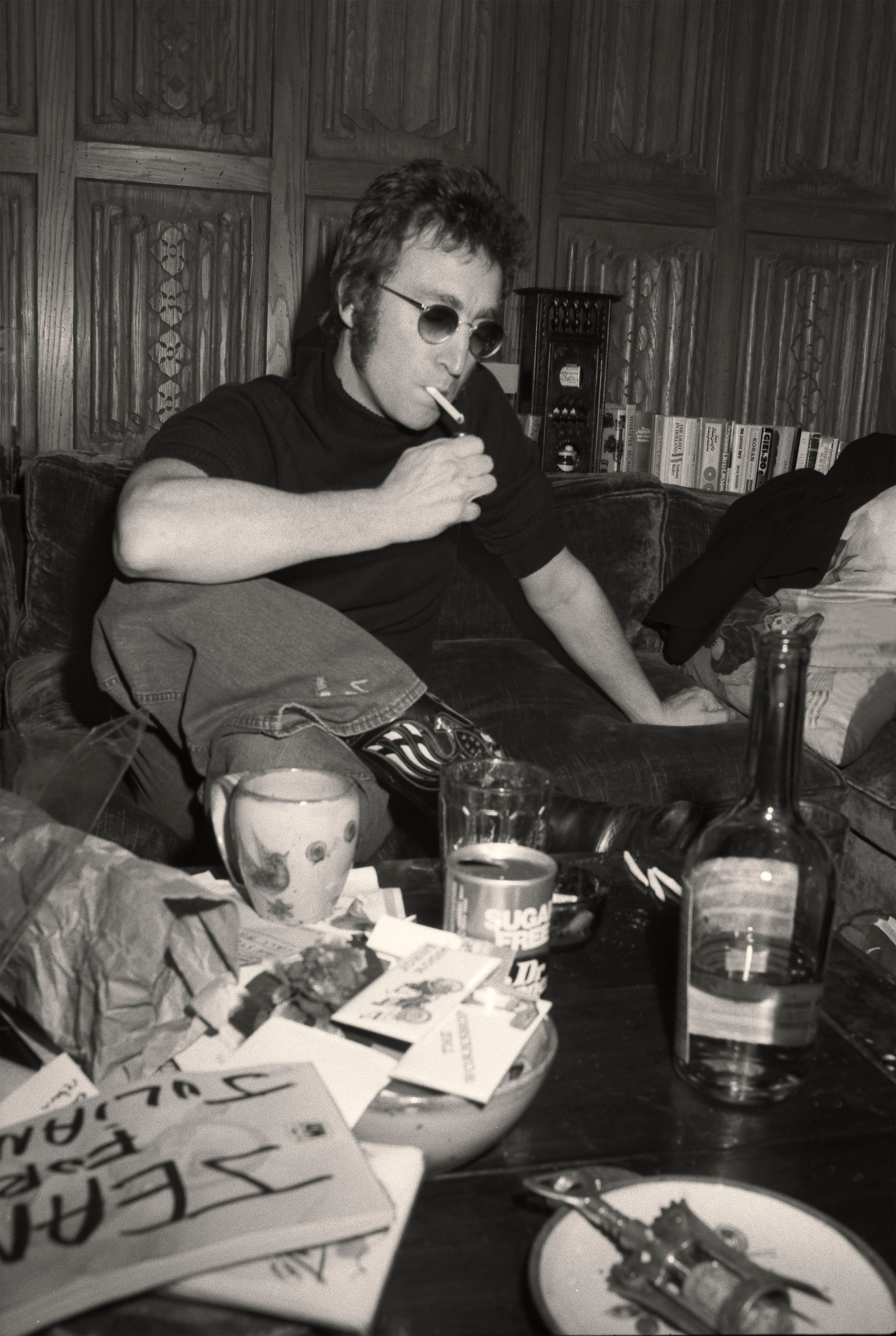
John was obviously tired, but he seemed determined to be a good host. He made tea and served us. Curiously, I never saw May Pang during my time at the house, nor did I think to ask where she was. Neither did Scumpy or Breschard that I remember. Then, after some small talk in the kitchen, we made our way to the living room, where I sat on a chair across from the others who sat on an L-shaped sofa. John smoked cigarettes as he fielded questions. My job was to take black-and-white candids of him with his two interlocutors. I was also asked to shoot some color headshots for a possible Crawdaddy cover.
Asked about songwriting, John said songs did not begin with tidy subjects so much as with feeling; they came out, he said memorably, “like diarrhea.” If he could just “open the plug,” the work would do itself.

Before Scumpy and Breschard were ready to wrap up the interview, John unexpectedly declared he was done. Tired? Peevish? Hungover? Don’t know. But Scumpy and Breschard were taken aback and implored him to let them finish.
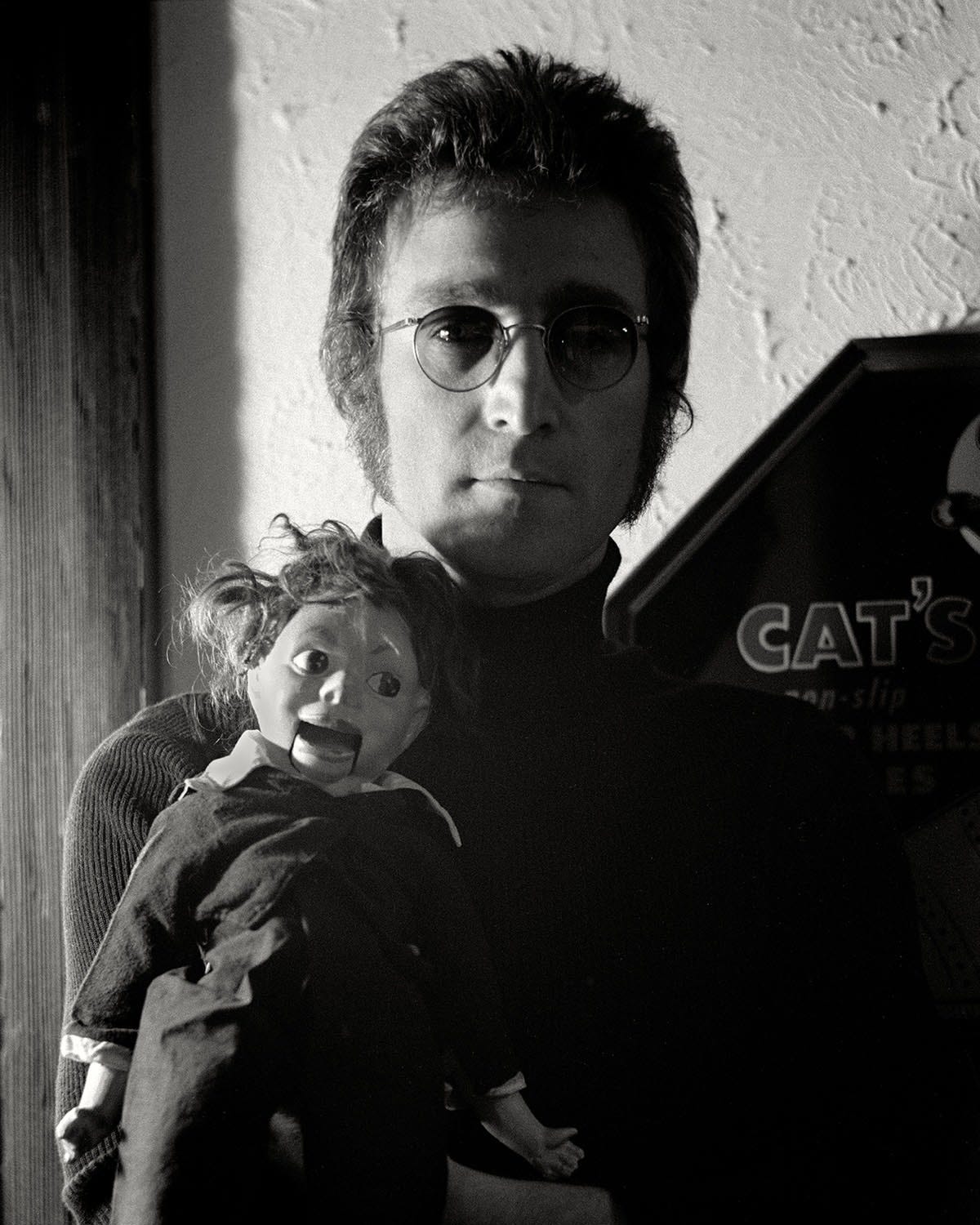
I’d like to think I saved the day by butting in uncharacteristically and suggesting that John might continue with the help of a ventriloquist’s dummy that caught my eye, resting on a table next to the sofa. It was one of many tchotchkes left lying around Adler’s house, and it somehow reminded me of the escalating Watergate scandal that was much in the news, how politicians often relied on “plausible deniability” when interviewed by reporters. I told John he could disavow any quotations published in Crawdaddy if they gave him second thoughts by blaming them on the dummy. He liked the idea. John kept that puppet on his lap throughout the rest of the interview, maybe fifteen or twenty minutes more, working its mouth up and down with a string.
After Scumpy and Breschard had gone, John let me hang out for several hours to shoot more pictures. Would he let me set up my camera and tripod and pose for a portrait? Yes. It seemed like he went out of his way to make me feel comfortable, perhaps understanding what it was like for a mere mortal to be spending time alone with John Lennon.
Because I didn’t yet own any electronic flash or incandescent lighting gear, I sourced a skylight in the bathroom above a wall-mounted mirror. Together, they would illuminate John nicely from camera left if he would agree to pose on the only seat there was, which, of course, he did. I used the dummy as a prop to memorialize its role.
A color candid was indeed chosen for the Crawdaddy cover. Around the time it hit the newsstands, John was involved in a notorious kerfuffle at the Troubadour nightclub in West Hollywood, which helped sell a lot of magazines and popularize my pictures.

On hand for a performance by singer Ann Peebles, a drunken Lennon stood on a tabletop and pranced around wearing a sanitary napkin tied to his forehead.
“Do you know who I am?” he reportedly asked the staff, finally manhandling him out of the club.
“Well, yeah!” shot back a waitress resentfully from the sidelines because Lennon didn’t leave her a tip, “You’re some asshole with a Kotex on your head.” That’s how Rolling Stone reported it, and you’d think that would have been the climax of The Lost Weekend. But John made an encore. He got eighty-sixed yet again from the Troubadour a couple of weeks later. This time, it was for heckling the Smothers Brothers during their comedy routine. Tommy Smothers’ wife said Lennon lost his trademark spectacles when punches were thrown curbside. They ended up with her.
Eventually, Yoko Ono came to John’s emotional rescue. She helped him climb out of depression to reclaim his powerful voice and character. As for his ordeal with Nixon, he once wisecracked, “Time wounds all heels.”
A proud moment came years later when a friend visiting the U.K. said he’d seen my portrait, “John Lennon with Dummy,” in the National Portrait Gallery in London.
On December 4, 2006, an hour-long cassette tape made by Jack Breschard during his and Scumpy’s interview with Lennon sold at Christie’s auction house in New York City for $38,400.
In 2008, Lennon’s eyeglasses—lost after his second tussle at the Troubadour—were sold by Tommy Smothers’ wife to a collector. My photographs of him wearing them were used as proof of provenance to close the $125,000 sale.
I wasn’t compensated further for my help with those sales. It sure would have been nice if whoever bought that tape bought one of my prints of Lennon to go with it. C’est la vie. I sure would like to hear that tape, though, because I don’t remember if John used a campy voice with the dummy or if he spoke in his natural voice. I’m sure it would be entertaining to hear it. Regardless, I’d hear my young self suggest to John Lennon that he let it speak for him, and I’d hear him speak to me.
Share this story!
Coming Attractions!
A brief detour: Next week I’m going to publish an essay.
No lectern involved. No homework. Just a thought worth chasing.
More stories about life shooting assignments will continue straight away. But from time to time, I want to explore some larger ideas about photography itself: memory, portraiture, visual culture, and what happens to photographs once they drift loose from the moments that gave rise to them.
A Photographic Memory was always meant to be a mix of stories, pictures, witness, and reflection. The next post leans a little more toward reflection.
After that, we’ll head back into the field.
Tom
. . .
My grandfather has strong feelings about paid subscriptions.
Who needs subscription banners from The New York Times, The Atlantic, Harper’s, or The New Yorker? Who needs NPR and PBS pledge drives when you can be just as earnestly dunned for money—and made to feel faintly guilty—by A Photographic Memory?
I mean, come on. What’s more important than preserving firsthand stories from the golden age of magazines, when expense accounts were large, common sense was optional, and a ringing telephone could send a photographer anywhere from John Lennon’s living room to the inside of a nuclear submarine?
For the price of one tall latte a month, you can help keep these stories coming—and support an independent publication with no corporate parent, no tote bag, and, so far, no matching grant from viewers like you. Thank YOU.
The photographs are the way in, but the writing carries its own weight. Become a paid subscriber. The coffee will be gone in twenty minutes. The stories and the pictures, with any luck, will outlive us all.
It’s not nostalgia. It’s witness.