A Cold Call, It Was
The Force Was with Me

I. Skywalker Ranch
The 1989 Mill Valley Film Festival, in association with the Hanson Gallery in neighboring Sausalito, was about to present an exhibition of my portraits of movie directors, actors, and screenwriters. I was billed as a “Featured Artist” along with director Tony Richardson and actor James Woods, who would both make a public appearance with me on opening night. And my friend, rock ’n’ roll photographer Jim Marshall, introduced me on that auspicious evening to the woman who would become my ex-wife.
Heady days.
A week or so before the opening, I was in the gallery with the staff, putting our heads together about how to hang the installation, when it dawned on us that I’d never photographed one of the most illustrious cinemagicians in film history, practically a local hero who lived and worked not so far, far away: George Lucas. Skywalker Ranch, the Lucasfilm production facility, was a twenty-minute drive from the gallery.
It usually takes the clout of a major magazine assignment to get a famous face in front of a lens. I mean a private, exclusive photo session, not that paparazzi crap. But I had never been assigned to photograph Lucas. I had photographed Francis Coppola, though—the godfather of the county right next door: Napa. So it would be fitting—practically vital—to round out the exhibition with a portrait of the biggest movie mogul in Marin.
But that put me in a bind. Once the idea went up the flagpole, it was hard to miss the unspoken imperative. All eyes in the gallery were on me. I grabbed a telephone and called Information: 411.
The operator answered, “What listing, please?”
“Skywalker Ranch,” I said.
I heard the rustle of pages turning. I half-hoped the number was unlisted. Oh! She found it. I thanked her, got a new dial tone, and tapped out the seven digits she gave me. I was still being stared at. A moment’s pause, silence on the line. Then, two rings. A receptionist picked up. “Skywalker Ranch,” she said.
“Mr. Lucas’s office,” I said. “Mr. Zimberoff calling.”
I gave her my best strictly business voice. I didn’t wait for her to ask who was calling. I’d heard businessmen and lawyers start calls that way, curt but not rude, underscoring an air of authority, implying that being put right through was expected. Maybe she’d think I was “Mr. Zimberoff’s” personal assistant. Or maybe I thought I could invoke the Force.
“Hold please,” she said.
I shot my colleagues a raised eyebrow, the telephone’s receiver up to my ear. I’d gotten lucky with the receptionist, but surely the next voice on the line would be a gatekeeper, likely to pass me on to another and another… But seconds later — the Force, indeed! — I heard, “This is George. What can I do for you?”
I am certain George Lucas had no idea who Mr. Zimberoff was. Maybe he didn’t screen his calls. Maybe his secretary was on a break. I pulled it together in a snap and introduced myself through my affiliation with the film festival and the exhibition. Then, I launched nervously into my pitch.
George didn’t say much other than to mutter an inquisitive “yeah” or “mm-hmm,” which mercifully encouraged me to go on. I explained how a gallery exhibition paying tribute to the movies would be outrageously incomplete without his portrait . I rattled off a few A-list names already included in the show, hoping, I suppose, to appeal to his ego (if not mine).
No reaction.
I got the feeling that George—alpha dog of industrial limelight and magic—didn’t care to bask in it by association with others. If he indulged me, it would be for the benefit of the film festival, not self-aggrandizement. Besides, Marin County has its vanities, but mistaking celebrity for substance doesn’t seem to be one of them. It is a long drive to Hollywood, in more ways than one.
It was also self-evident that my phone call was a spur-of-the-moment Hail Mary. I confessed as much, apologizing in advance for the narrow window we had for a photo shoot if he agreed. I hoped I hadn’t sounded desperate by the time I asked, “Will you let me photograph you?”
I expected him at worst to turn me down flat or at best string me along with an offer to have someone call me back. But right then and there, he agreed. I thanked him, probably too many times in one sentence.
The call ended with George’s invitation to visit him at the ranch.
I wore an uncontrollable smile when I hung up the phone. Everyone in the gallery was surprised by such a fortuitous outcome. And it happened so fast. I should have rushed out to buy a lottery ticket.
II. The Warehouse
I drove to Skywalker Ranch the next morning. The ranch house, an Arts & Crafts–inflected country lodge, was the hub of a working campus sprawled across hundreds of acres of rolling hills and golden grass punctuated with oak trees. Just off Lucas Valley Road in Marin County, it epitomizes a pastoral California landscape. Although neither the road nor the valley was named for this Lucas, the coincidence had to be the cherry on top when he bought the property.
My first order of business was face time with George to establish rapport and noodle some ideas about where on-site we might stage the shoot. But it was Yoda’s face I saw first, just inside the ranch house foyer.
The Grand Master Jedi himself—so entrancing it felt as if he might reach out to me and speak—stood self-assuredly on a plinth, an official greeter. Every wrinkle on his wise and ancient face, the intricate folds of his robes, the glint in his eyes, pulled me toward a presence that edged right up to life. Could he be sizing up my worthiness for the meeting ahead? I stood before him, awestruck.
I might have bowed, but the spell was broken by an employee who ushered me straight away into Lucas’s office.
George got up from his desk and welcomed me with a handshake. We sat down across from each other. I was keenly aware of how many people must approach him, wanting something, hoping my nervousness wouldn’t get in the way of what I wanted from him myself, even though I wanted to give him something, too: a classy portrait that would also raise some money for the MVFF.
Normally, I’d show up for a photo shoot ready with one or two ideas in mind, something to get the ball rolling. But this time, because it had all come together so unexpectedly, I had nothing. With less than a day to prepare, I was still wondering how to portray such a familiar face and do it creatively—how to put my stamp on it. I didn’t want to come off as unsure, but I was hoping we could arrive at an idea together, after knocking a few back and forth over the desk.
George, though gracious, was not the talky type. He wasn’t exactly taciturn, but our conversation kept slipping into pockets of silence, which I’ve never been particularly good at navigating. I tried bringing up his film-student days at USC. I went there too. Fight on! That got a rise. Then I told him how wowed I was when I saw Star Wars for the first time in 1977. Duh. Everyone thinks they have to tell George Lucas about the first time they saw Star Wars.
Where was I going with this?
Time flies, and I needed to land on an idea. Fast. My instinct was to play it safe with a plain background, maybe get George to pose with a movie camera, a Klieg light, or a director’s loupe. I’d included a scene slate—a clapboard, as in, Whack! Take 2—in two other portraits already: Coppola’s and DeVito’s. I could play it safe with a tight headshot, mining the character and drama in his eyes. That’s always a good fallback. Finally, I asked George outright if he had any suggestions. He reached for his desk phone, buzzed an extension, and asked Don Bies to join us.
Bies was the Lucasfilm archivist. As he walked into the office, George tossed him a set of keys, which were caught in midair, and asked him to drive me to “the warehouse.” George said I could rummage around in there for props. It was halfway back to Sausalito, south on 101, in the town of San Rafael.
Half an hour later, Bies and I pulled up in front of a nondescript building on a narrow street in an industrial neighborhood: auto-body shops, furniture upholsterers, car stereo installers. I was clueless. There was no signage on the building. No architectural distinction of any kind. Don approached the equally nondescript entrance, unlocked a deadbolt, and swung the door open.
I looked inside.
I felt a thrill that could only have been equaled by what Howard Carter and Lord Carnarvon experienced when they peered into King Tut’s tomb for the first time. Confronting me was the archetype of intergalactic doom: the Death Star. It was only about the size of a big beach ball, but—come on!—it was the real deal, the goddamn Death Star, not some intangible computer-generated image. C-3PO and R2-D2 were standing right next to it. I turned my eyes toward, well, did I say I was looking for props?
Arrayed on shelf after shelf with—I don’t know—a small battalion of Storm Troopers standing guard, was a cornucopia of familiar and beloved treasures. Gazing back through the fog of time, the building that housed this trove seemed as cavernous as the military surplus depot at the finale of Raiders of the Lost Ark. But it couldn’t have been quite so unfathomable because with no effort at all, I found it: the Ark of the Covenant.
I was surrounded by Star Wars and Indiana Jones artifacts, one-of-a-kind objects handled and worn on screen by the immortal cinematic heroes of our time. They were arrayed with the pallet-stacked abundance of a Costco warehouse devoted entirely to myth.
Here were the lightsabers. I could touch them. I could hold them. Here was the robe that adorned the Emperor of the dark side. I tried it on. Here were Indy’s whip, his fedora, his bomber jacket. There were handmade scale models of Imperial Star Destroyers, Corellian corvettes, and TIE fighters… Han Solo’s Millennium Falcon. Okay, not full-scale. But here was Darth Vader’s full-scale head.
I could go on. I did go on, engaged in a fantasy shopping spree, picking some of this and some of that, along with a few of those, and piling it all onto a dolly to push back to Don’s car. I could hardly imagine what might have happened if we’d gotten into a fender bender or been stopped by the Highway Patrol with all this booty on board.
I could think of any number of museum curators who would have had a conniption fit if they knew we hadn’t worn white gloves and hired cops on Harleys—lights and sirens—to escort this stuff, crated, tied down, and transported in an air-shock-equipped armored van. But having avoided any consequences, we dropped everything off at Skywalker for my shoot the next day.
When I returned to the ranch, my new rep came along, Britta Lee Cox. It would be good for her to watch me at work. (Britta’s entrepreneurial zeal led her, years later, to become a major figure in the world of women’s hair care products, as the founder and CEO of Aquis.) But I was flying solo that day; too last-minute to book one of my regular assistants. It took me an hour to set up my camera, lights, and backdrop in George’s office while Britta kept him occupied, schmoozing. Then, George had to take care of some business, so Britta and I explored the Skywalker Ranch library.
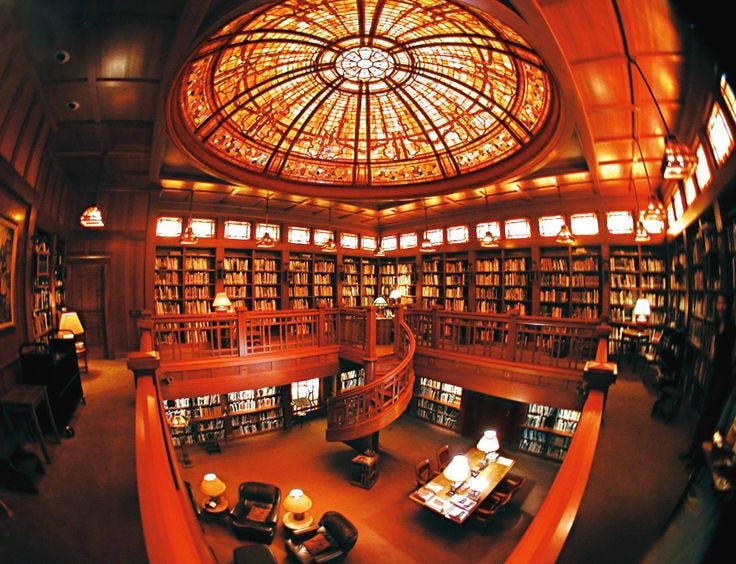
It was a magnificent two-story, wood-paneled chamber with a spiral staircase leading up to a stained-glass dome, already familiar to me as the site of journalist Bill Moyers’s videotaped interviews with scholar Joseph Campbell. They had aired serially on PBS TV the previous year, 1988.
Campbell enchanted millions with his explication of the “Hero’s Journey,” a comparative deconstruction of mythological themes that have recurred throughout the literature and religions of all cultures since the dawn of civilization. Those stories were Lucas’s inspiration for Star Wars—with some Sergio Leone spaghetti Westerns and Akira Kurosawa samurai sagas thrown in for good measure. Lucas brilliantly appropriated the genres of Western cowboy and Eastern samurai and took them both into outer space. It was a transcendent experience for me to be in that library.
Back in George’s office, I realized I must have bored him with my “first-time-I-saw-Star Wars” testimony. But I could hardly avoid reliving that episode, twelve years earlier, vividly in my memory.
There was already a buzz in the air, but the movie hadn’t yet been released when I saw it. Only small groups of industry insiders and critics had had that privilege.
My apartment, just off the corner of Almont Drive and Wilshire Boulevard in Beverly Hills, was less than a hundred yards from the Academy of Motion Picture Arts and Sciences and its private screening theater. My brother-in-law, Mike Roshkind, a member of the Academy, sometimes let me borrow his special screening pass.
I walked over with a girlfriend. We had no idea what to expect when the lights dimmed.
BAM! There it was, thirty feet high, accompanied by John Williams’s over-the-top brass fanfare: A LONG TIME AGO IN A GALAXY FAR, FAR AWAY…
It may have been the first time a full audience had ever beheld that now-signature backstory introduction, crawling up the screen with its exaggerated wide-angle perspective—a paean to the Flash Gordon serials I’d watched as a kid on a black-and-white TV. We knew instantly that something special was happening. Our screening experience was not without chemical enhancement, which only heightened the fun.
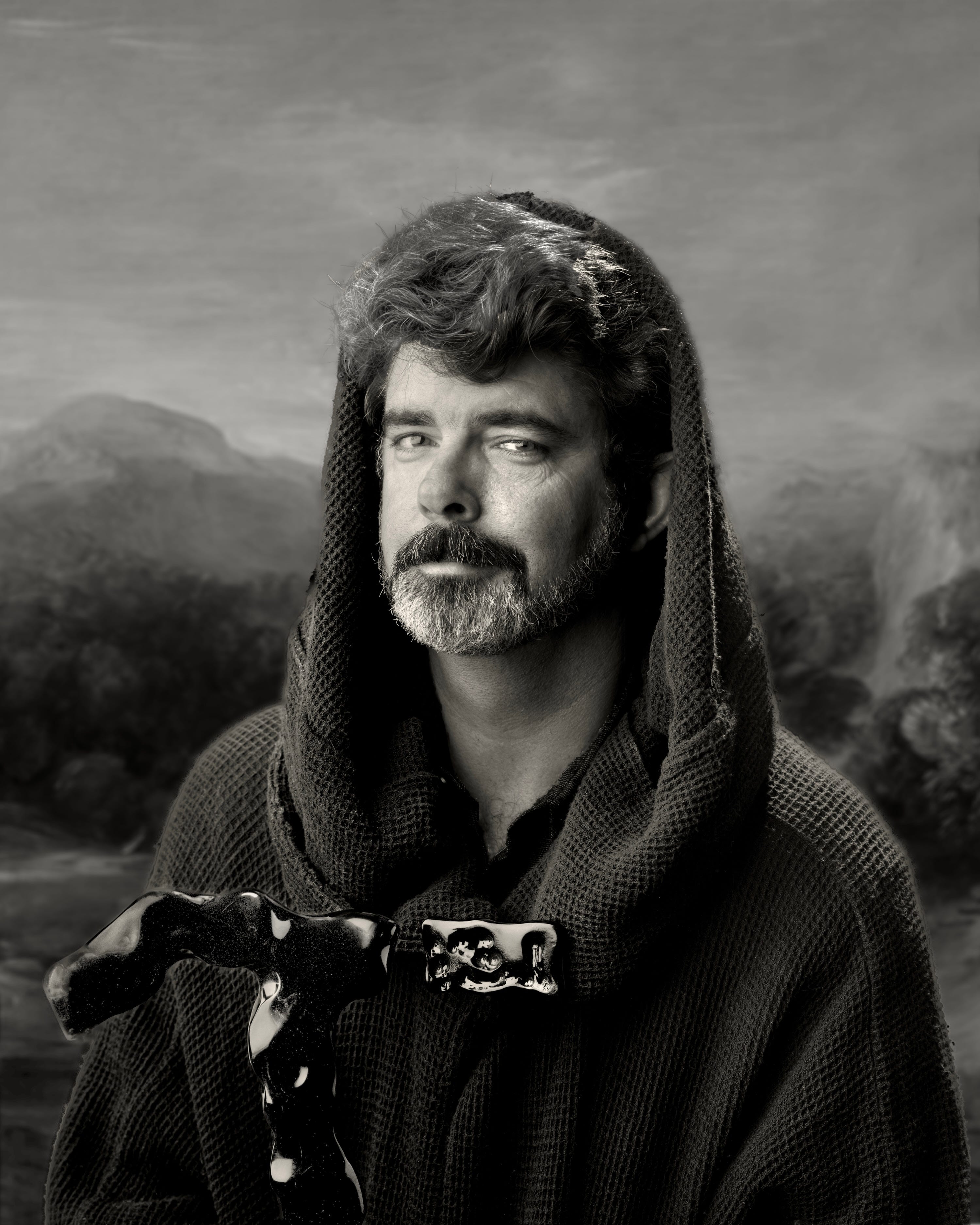
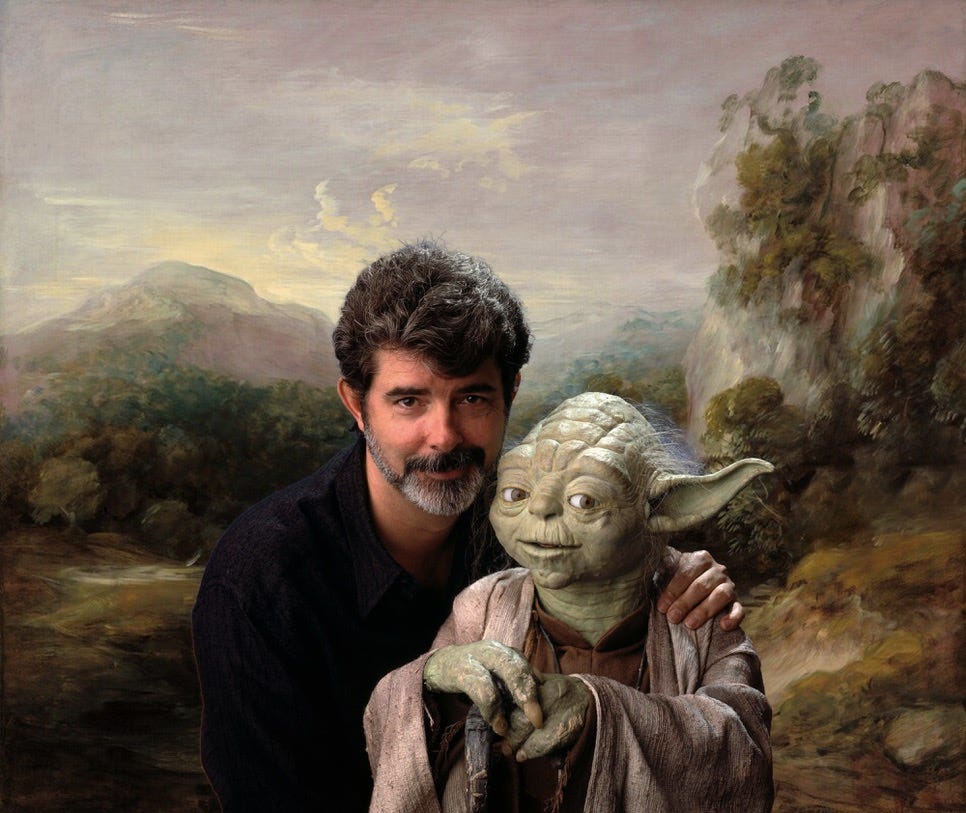
Initially, I posed George wearing the robes of the Emperor of the dark side. It was a good start. He enjoyed that guise. In the photograph, you can see he’s got a cheeky little Mona Lisa smile going on. But something was missing.
Here we were with all these props. I’d been given carte blanche in the candy store. I hardly knew what to do with all the candy. I had considered dressing up George as Indiana Jones, whip and all. Too camp. Wielding a lightsaber? Well, that would look great, but because I was working without an assistant or a stylist, I didn’t have time to change the set or rig lights and camera effects; those sabers don’t run on D batteries. Yet, here, in the place where all things magic occur, I couldn’t think of one thing to ignite my mojo. I was getting worried, too, that George might get impatient. Then — whoa!—I ran right into the kind of obviousness that makes you smack yourself upside the head: Why, it was Yoda, of course!
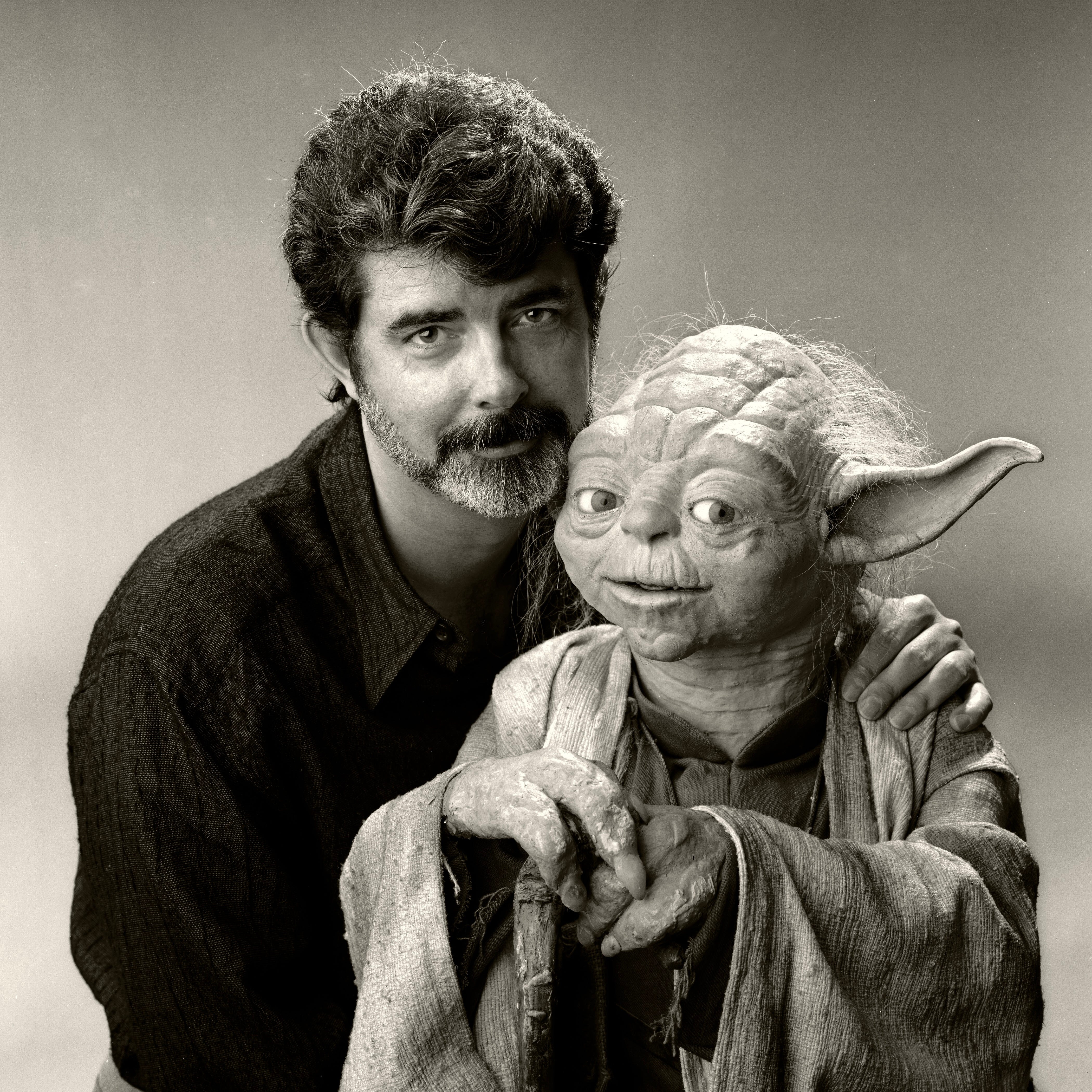
I rushed back to the reception area, grabbed the little green guy, and carried him lovingly back to George’s office.
Britta kept George in a playful mood once our Jedi was on the set. He enjoyed watching her bound into frame over and over again to rearrange Yoda’s eyeballs, which bobbed uncontrollably whenever he got bumped, like he was rolling his eyes at us facetiously.
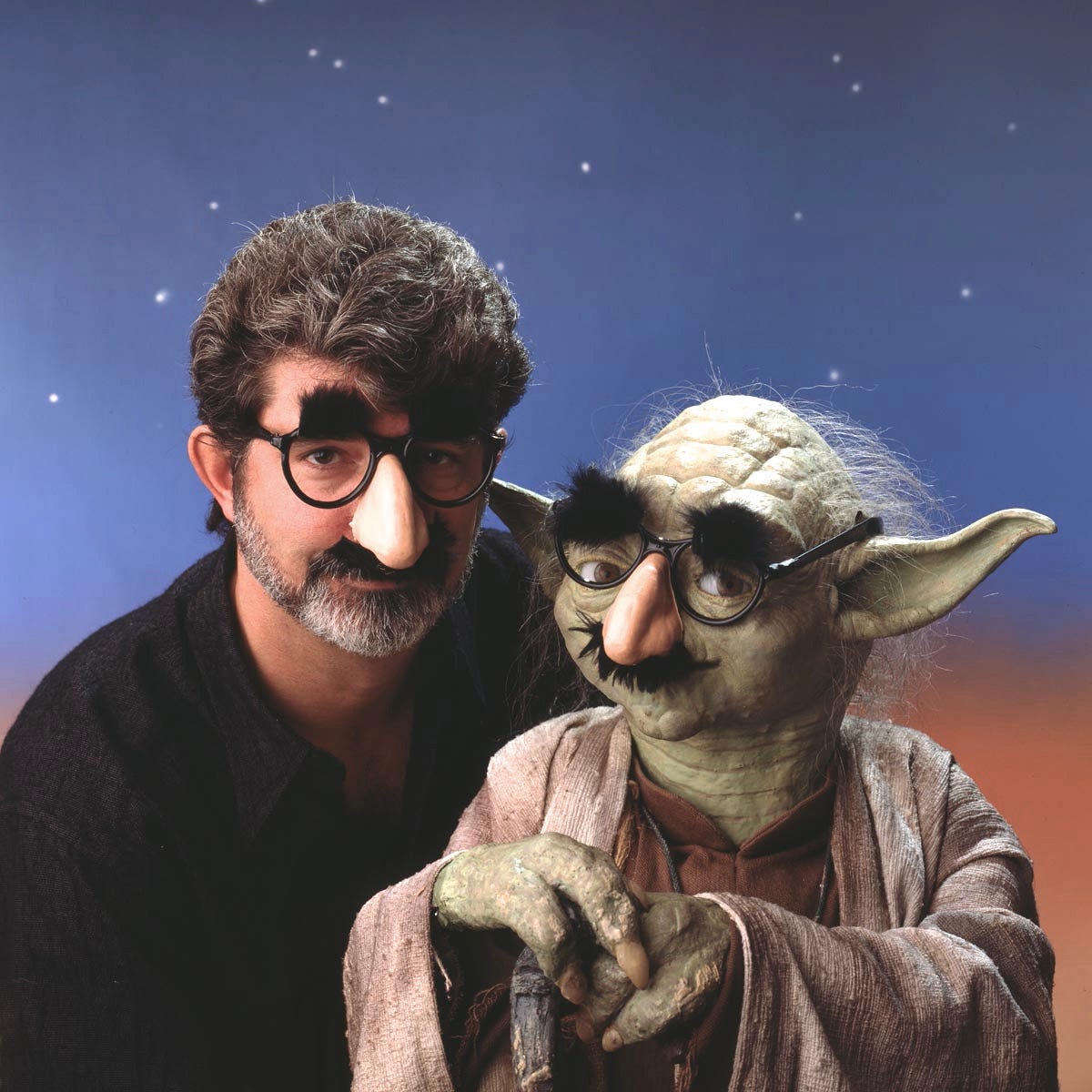
All in all, I think the camera reified George’s and Yoda’s interstellar bromance. They posed together on set, with Britta’s help, for about an hour while I exposed fifty-one 4x5 sheets of film, both color and black-and-white, through my bellows view camera. I couldn’t do better than capture the Jedi of all Jedi posing with his George, his protégé.
Wrap.
But what kind of crazy luck this was! Considering what I’d been up against, this photo shoot should never have happened. The Force was with me. I wish I could have hung out and kibitzed with George, but we had just enough time to look at some Polaroid test shots before I took off for the lab with the rest of my film.
At the Hanson Gallery, the opening-night crowd spilled onto the street. TV news crews from San Francisco set up lights and interviewed the attendees. Me, too. My friends and family came to mingle. Woods and Richardson were there. The show stayed up for weeks. A percentage of the proceeds from print sales went to support the Film Festival. We had no high hopes that George would show up. He didn’t. But I’ve long wondered, since George’s portrait sold, if someone bought it on his behalf.
III. The Hit Parade Goes On
In my world, coincidences don’t end. They get freakier.
A few days later, the president of Costa Rica and Nobel Peace Prize laureate, Oscar Arias, was on his way back to San Francisco after a tour of Wine Country. His small motorcade, escorted by the U.S. Secret Service, detoured through Sausalito to enjoy a magnificent view of the San Francisco skyline from the waterfront on the Bridgeway promenade and passed by the Hanson Gallery, where Arias saw my prints in the window. Big window. Big prints: John Huston, Paul Newman, George Lucas.
Arias stopped his motorcade. Everyone went inside. That alone is a story worth telling. But here’s the thing: one day after that impromptu visit—still unbeknownst to me—I was asked to photograph Arias.
Wine Country was just a side trip; he was in California to witness the phenomenon of Silicon Valley innovation, where he was fêted by Apple CEO John Sculley. It was Sculley who asked me—via a phone call from Amy Bonetti, his assistant—to take some grip-and-grin pictures in his home with Arias after an intimate dinner party. Sculley was apologetic, Amy said, because, this was no ad campaign or book-jacket portrait; merely some flash-on-camera snapshots (like my press-party days). But he’d consider it a personal favor, she told me, because he didn’t know who else to call on short notice.
I saw an opportunity to ask for a quid pro quo: the pictures would be my treat—no charge—if Sculley would broach the idea to Arias of sitting for a portrait. No obligation to agree—just the ask. Done. Arias agreed.
Neither Sculley nor I had any idea that Arias had seen my exhibition. Arias had no idea I was that photographer. The stunning coincidence was only revealed when I showed him my portfolio in Sculley’s study, lights and camera already set up. After some astonished laughter, we got down to the business of a portrait.
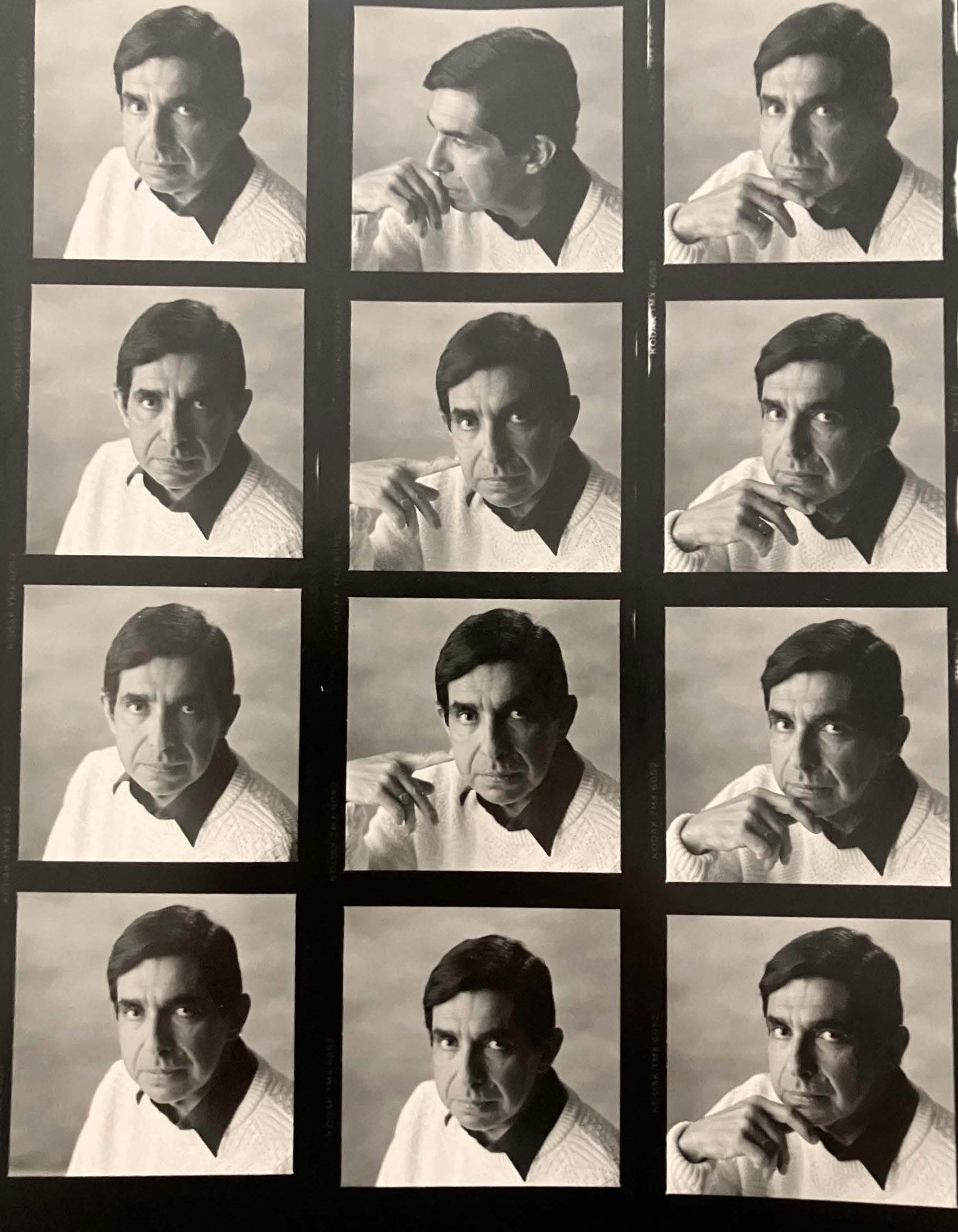
Weeks later, after I sent Arias a copy of his portrait with my compliments, he sent me a formal invitation to visit him in Costa Rica. As president, he was not required to use postage stamps; franking—his handwritten title and signature on the envelope—was enough, a privilege afforded to heads of state. However, some bureaucrat in the U.S. Postal Service must have thought that a letter from the President of Costa Rica without a stamp was some kind of prank. Or perhaps it was set aside to be checked for legitimacy, then forgotten before forwarding it to my address. In any case, I received it eight months after it was mailed.
When I telephoned Arias’s secretary to tell her what happened, she advised, “He’ll be happy to receive you. But you know he is no longer president.”
Months after the Hanson show, on a flight home to San Francisco from L.A., Molly and I—before we were married, and long before she became my ex—bumped into George as we disembarked from the same plane. He had boarded up front in first class after Molly and I had already been seated farther back in coach. The three of us walked together to baggage claim, chatting about movies and the photo shoot at Skywalker. He seemed perfectly at ease standing at the carousel with us, among other passengers who tried hard to look like they were ignoring him. We said our goodbyes as the carousel spun off Molly’s and my luggage first. She and I went on to the airport parking lot.
On the drive home, north on 19th Avenue toward the Golden Gate Bridge, Molly spied George at the wheel of his car. We were tied for pole position at a red light. I beeped my horn. We made eye contact. He put on the same sly grin that appeared while posing in the Emperor’s dark hoodie.
My imagination segued to American Graffiti. Did he have a similar thought?
We revved our engines in neutral, leaned into our steering wheels, and let off our brakes when the light turned green, faux-racing to the next red light.
We weren’t going fast at all, just scowling out our windshields with a little eyebrow action, like kids driving parked cars toward an imaginary finish line. One more intersection. Then, by the time I could see the towers of the Golden Gate Bridge peeking over the rooftops, I lost sight of George in traffic.
Fade out.
Who needs subscription banners from The New York Times, The Atlantic, Harper’s, or The New Yorker? Who needs NPR and PBS pledge drives when you can be just as earnestly dunned for money—and made to feel faintly guilty—by A Photographic Memory?
I mean, come on. What’s more important than preserving firsthand stories from the golden age of magazines, when expense accounts were large, common sense was optional, and a ringing telephone could send a photographer anywhere from John Lennon’s living room to the inside of a nuclear submarine?
For the price of one tall latte a month, you can help keep these stories coming—and support an independent publication with no corporate parent, no tote bag, and, so far, no matching grant from viewers like you. Thank YOU.
The photographs are the way in, but the writing carries its own weight. Become a paid subscriber. The coffee will be gone in twenty minutes. The stories and the pictures, with any luck, will outlive us all.
It’s not nostalgia. It’s witness.
Coming Attractions!
Next week: how a twenty-one-year-old rookie photographer got John Lennon to sit for a portrait—and came away with his first magazine cover.