
Photobesity
Smartphones didn’t democratize photography so much as turn personal memory into a storage problem.

By the turn of the millennium in Japan, teenagers were crowding purikura kiosks in shopping malls, train stations, and bowling alleys, making decorative photo stickers to trade with friends. They were already in the habit of adorning text messages with emojis. At the same time, mobile phones were becoming instruments of everyday social exchange.1
Manufacturers soon recognized this convergence and the potential for new revenue streams. Within a few years, rudimentary cameras had been embedded in phones, allowing pictures to be made and transmitted almost instantaneously. The evolution of the smartphone continued worldwide.
A generation raised on the internet and the iPhone has come to understand photography, if they give it any thought at all, as a seamlessly integrated and effortless part of everyday life: just one more quotidian activity, whether illustrating what you ate for lunch or taking a picture of a picture already hanging on a museum wall, automated by technology in ways that further subordinate human decision-making. Not talking about pros, of course. Not even serious camera enthusiasts; just legions of ordinary people compulsively taking picture after picture, hoarding them, and never looking at them again after their first fleeting appearance on a tiny screen.
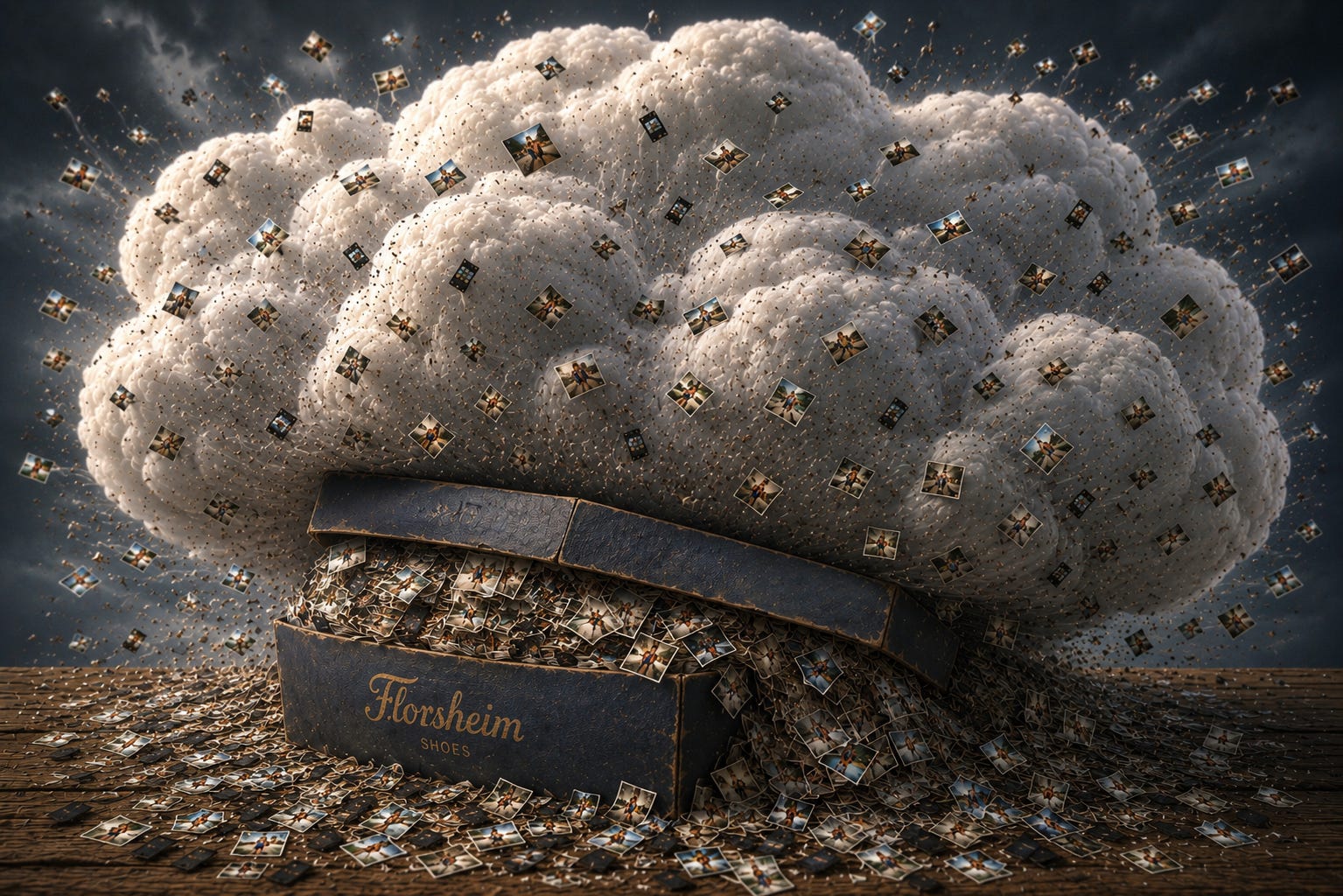
Our society once cherished the “Kodak Moment,” a marketing masterstroke that now seems quaint, a casualty of what I call photobesity: the chronic accretion of snapshots made with such mindless frequency that yottabytes of digital dross have congealed into a bolus of memories that’s too big even for AI to swallow. Once carefully curated and displayed with pride on special occasions, our visually preserved memories now languish in a virtual vault. It is visited even less frequently than that proverbial shoebox full of family vacation photos forgotten in a dark closet. It’s now called the cloud. And we are continually nickel-and-dimed by Apple, Google, and Dropbox to pay for ever-increasing gigabytes of ephemeral storage space for our abandoned pictures.
Set aside the environmental cost of maintaining such a billowing cloud: enormous server farms guzzling aquifers, gorging on megawatts, and choking on petabytes to keep our snapshots on life support.2 The toll is more than planetary. It’s psychic.
These orphaned images exact a toll on our eidetic memories, the deeply embedded kind that linger in our mind’s eye and would otherwise resurface vividly and be welcomed unexpectedly throughout our lives. Instead, the very act of snapping too many pictures may distance us from the moment itself, trivializing it: The camera captured it, so I don’t have to remember it. The result is a paradox: the sheer volume of images leads to forgetfulness.3
Memories are better held in the heart than on an iPhone.
I seem to have made an argument against digital photography. That was not my intention. But it serves to call out a trend among fine art photographers, many of whom have turned to obsolete cameras—from 35mm SLRs to big bellows view cameras—so they can shoot film. Based on my own completely unscientific psychological analysis, I’d say their rationale is simple: it’s harder. In their minds, difficulty equals virtue.
Exposing film, whether sprocketed rolls or sheets the size of an iPad, then developing it and enlarging prints in a darkroom filled with acrid potions, may offer some photographers a greater sense of accomplishment. On the other hand, they could be trying to atone for a sense of guilt: If it’s too easy, anyone could do it. While some are surely driven by fetishized nostalgia, I think, on the whole, they want their audience to believe in the film-as-virtue narrative because they’ve made it an issue of personal identity: branding.
Some die-hards insist that shooting film, which is far more expensive now that the mass market has collapsed, makes them more discerning about when to press the shutter.4 The implication is not subtle: the rest of us trigger-happy digital shooters are machine-gunning exposures, hoping to get one good shot out of the whole nine yards. That’s nuts. Still, there may be a sliver of truth: some careless, marginally professional practitioners rely on algorithms to compensate for sloppy exposure habits. But cost does make people ration film, and thrift is not the same thing as judgment.
When film and processing were cheap, photographers bracketed exposures, firing over- and underexposed frames to hedge their bets, or kept shooting to make sure we caught just the right look in a model’s eyes because we couldn’t confirm it on a screen. In the heyday of magazine photojournalism, the amount of film I went through in a single day on assignment might exceed what a film devotee today exposes in an entire year.
I once had a client, a network-television photo editor, who admonished his minions and me, “Film is cheap; shoot by the pound!” It was the most practical way to create virtual “dupes” of color slides for distribution to affiliate TV stations and advertisers across the country. An unyielding shutter finger and a Nikon AA-battery-powered motor drive did the trick.
Well, that’ll never happen again. But professionals today, whether working with film or digital capture, remain conservative in the only sense that matters: they do not want to bury themselves in bad pictures. No serious photographer simply sprays and prays. Who wants to spend endless hours sifting through garbage in post-production, or, as we used to call it, editing? Even in the darkroom era, we used myriad techniques—masking and compositing (“sandwiching” color slides), dodging, burning, manipulating processing times and temperatures—to fix or enhance what film couldn’t capture on a first pass through the camera. We ribbed nose grease onto our negatives to mitigate the effects of scratches during enlargement, precluding the spotting of prints, later, as much as possible. Pre-Photoshop, such tricks of the trade accomplished many of the same results. They were just more cumbersome.
Consider Kodak’s famous slogan from the dawn of consumer picture-taking, back in 1888: “You press the button, we do the rest.”
That was as close as photographers got to instant gratification for a very long time. The only new development that matters here—yup, a pun—is not automation but immediacy: seeing an image appear instantly, electronically on a screen instead of waiting for film to be processed, then staining your fingernails brown with Dektol and selenium as you manipulate one sheet of paper at a time, sloshing it around in a tray under a safelight while an image slowly emerged as if remembering itself. And that was only black-and-white. Polaroids notwithstanding.
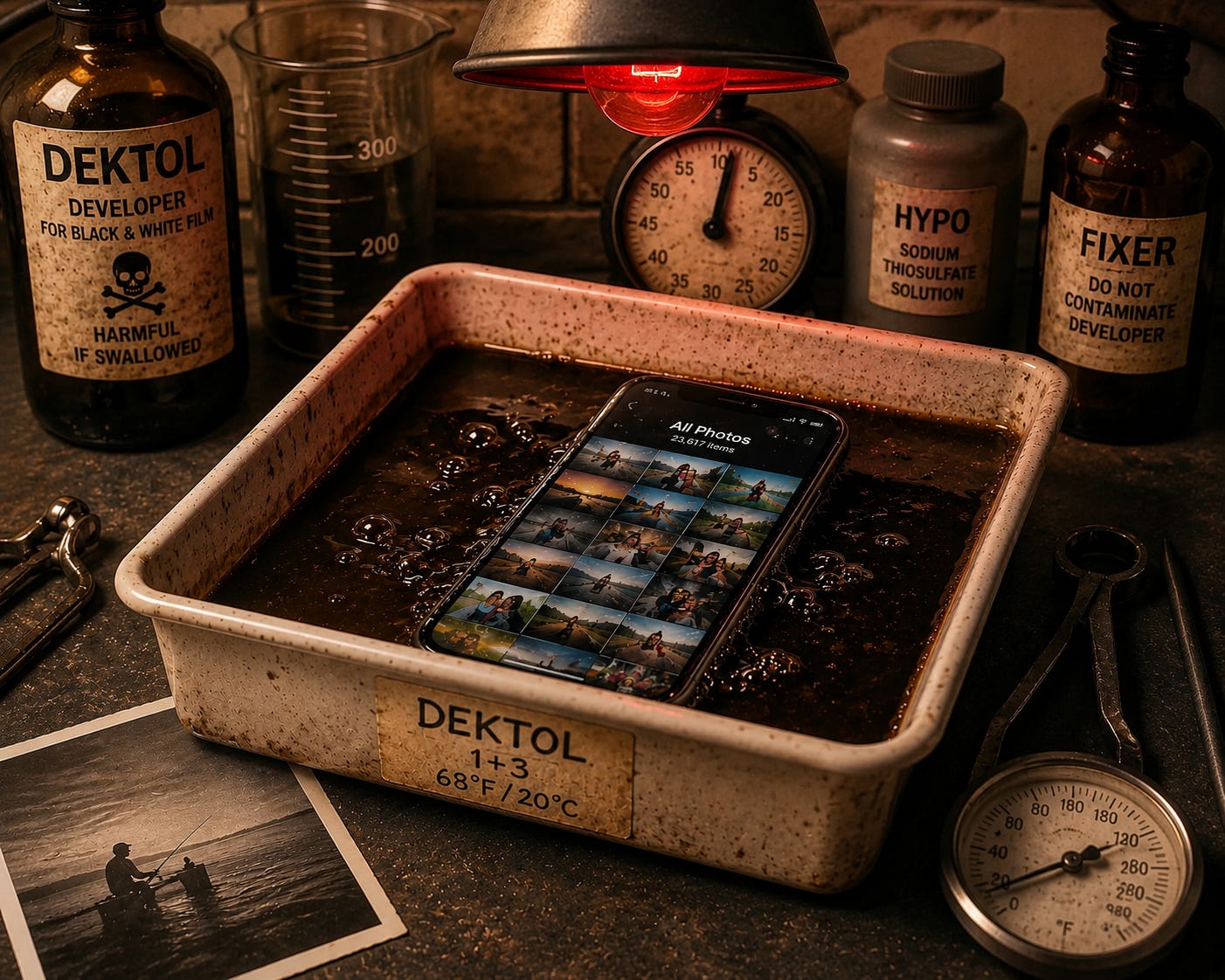
There was a time when no one chose between film and digital; the only decision was which film stock suited the job at hand. I processed my own negatives and made my own prints. I fondly remember the smell of gelatin emulsion—not so the reek of potassium ferricyanide and sodium thiosulfate. When film resurfaces today as a stylistic badge of authenticity, its darkroom ritual can feel artisanal, even romantic. But nostalgia should not obscure the technological reality: returning to film is not an advance. It is, at best, a preference.
Film and digital differ materially—chemically, mechanically, procedurally—but they are no longer qualitatively different in aesthetic outcome. Silver halide crystals and silicon sensors are distinct image-capture mechanisms. That distinction, however, confers no inherent superiority on either one in the finished print.
You may hear a common refrain among film purists: But I can see it!
Can they? Or do they merely recognize a set of visual cues they have learned to associate with film: grain, halation, tonal roll-off, color response, edge effects, and even the irregularities of particular printing processes? Those effects can all be modeled now; adjusted, or removed in software. The visible signature of the capture medium is no longer fixed. A digital image can be made to look analog; a scanned negative can be made to look digital. What the eye identifies is an appearance, not necessarily its origin.
Seeing is not neutral. It is interpretive. In aesthetic terms, this is perceptual expectation bias: the eye confirming what the mind already believes. From a technical standpoint, every visible property once claimed as uniquely filmic can now be replicated: grain can be simulated; tonal roll-off can be modeled; color response curves can be profiled; even halation can be emulated. So can the stained, goopy borders of large-format Polaroid prints, where developer paste pooled and dried into prized accidents. And high-end inkjet printing on baryta papers rivals or exceeds traditional silver-gelatin in depth of blacks, tonal separation, and repeatability.
I dare anyone to eyeball a qualitative difference between one of my inkjet prints and a silver-gelatin print of the exact same image, irrespective of digital or analog capture, without a loupe or chemical analysis. If two finished prints are visually indistinguishable without forensic inspection, the claim of inherent aesthetic superiority collapses. The remaining differences are material, not qualitative. They belong to process, not outcome.
A Smith-Corona and a MacBook Pro can both produce a finished manuscript. One slows the writer down. The other makes revisions easier. Neither improves the sentence. What remains is preference, not proof. Nostalgia is not an aesthetic argument.
Incidentally, if one insists on silver gelatin as the defining article of faith, it is entirely possible to produce silver-gelatin prints from digitally captured images by inkjet-printing an inverted image onto transparent media. The result is a digital negative for making prints on traditional photosensitive paper in a darkroom. Even the supposed boundary between media has dissolved.
I will say this categorically in favor of film: despite offering no inherent superiority in image capture, processed film remains the more practical medium for archival preservation.
Electronic image files stored in the cloud are neither invulnerable nor immutable. Whether viewed on an iPhone or a thirty-two-inch 8K monitor, such images are still merely verisimilitudes, not durable photographic objects with material presence and value. A print is an actual photograph. A screen image is a representation of a photograph, just as an offset-printed or lithographed reproduction of a photograph is a facsimile.
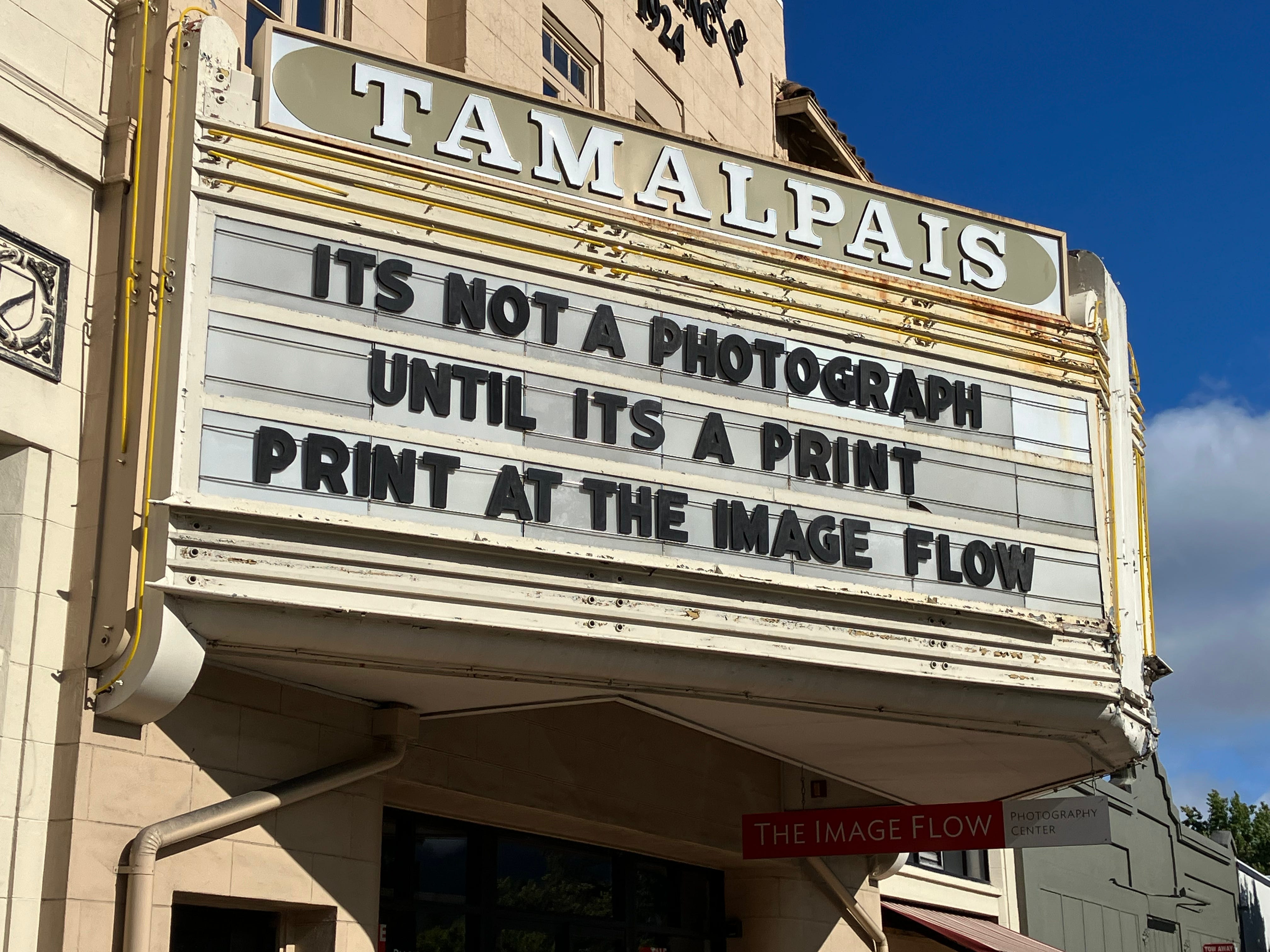
Film’s physical properties allow it to be conserved for posterity more easily than JPEG, RAW, TIFF, or DNG files stored in that fugacious shoebox in the sky, or even on a personal hard drive array. Then again, I won’t be around six hundred years from now to care. But sooner than that, if a not-too-farfetched solar flare fries AWS servers, or Russian malware reduces Google to gobbledygook, you are out of luck.
Extreme. I know. But what if you haven’t had the discipline to back up your photos regularly enough to keep up with the tick-tock of technology, let alone the physics of entropy, and those CD-ROMs you relied on years ago have succumbed to disc rot, a breakdown of the polycarbonate substrate, delaminating the whole schmear? Or what if, thirty years from now, no accessible computer can read those ones and zeros you so assiduously backed up to the cloud? On a more optimistic note, who knows how long it’ll be before we can store vast quantities of data inside strands of DNA, tiny double-helix repositories that could last millions of years?5
In analog days, I used to put my film in an envelope and stick it in a drawer, relying on the likelihood that my photographs would be seen by my descendants living on Mars, notwithstanding nuclear annihilation, fires, or floods on Earth in the meantime. In lieu of film, however, if you want to ensure your digital images last long enough to be seen by Jean-Luc Picard, I suggest you make prints of the ones that matter. Prints made from digital files on acid-free rag paper and archival pigments spit out by an inkjet printer, either color or black-and-white, will last as long as any silver print processed through the ritual of immersion in successive baths of chemical concoctions.6
For those who still evangelize film, the implication is familiar. By deliberately eschewing digital technology and favoring increasingly moribund darkroom alchemy, they suggest that their medium is the message. A superior one. Perhaps without giving it much thought, they lean on Marshall McLuhan in a way he likely never intended.
At its most theatrical, this zeal for antediluvian technology reminds my cynical side how ancient priests cloaked their rites in mystery, not so much to enlighten the uninitiated as to remind them who held the keys to the temple.
Taking photographs is and always has been easy. Making them never was—and still isn’t. My story, then as now—and the stories of all working artists and photojournalists on both sides of the analog-digital divide—is that we make photographs. Let the dilettantes and smartphones keep taking them, and taking them, and taking them…
. . .
Footnotes:
1. Daisuke Okabe, Mizuko Ito, Jan Chipchase, and Aico Shimizu, “The Social Uses of Purikura: Photographing, Modding, Archiving, and Sharing,” paper presented at the Pervasive Image Capture and Sharing Workshop, UbiComp 2006. The authors report that the first purikura booths were deployed in Japan in 1995 and that camera phones were initially piloted there in large part because manufacturers had observed teenage girls’ involvement with both mobile phones and purikura.
2. International Energy Agency, Energy and AI (Paris: IEA, 2025). The IEA estimates that data centers consumed approximately 415 terawatt-hours of electricity worldwide in 2024, about 1.5 percent of global electricity consumption. See also Google, 2025 Environmental Report, which reports that the company replenished 4.5 billion gallons of water in 2024, equivalent to 64 percent of its freshwater consumption.
3. Linda A. Henkel, “Point-and-Shoot Memories: The Influence of Taking Photos on Memory for a Museum Tour,” Psychological Science 25, no. 2 (2014): 396–402; Julia S. Soares and Benjamin C. Storm, “Forget in a Flash: A Further Investigation of the Photo-Taking-Impairment Effect,” Journal of Applied Research in Memory and Cognition 7, no. 1 (2018): 154–160. Both studies found circumstances in which photographing objects reduced later memory for them, although the effect is not universal and appears to depend partly on the attention and cognitive engagement involved in making the photograph.
4. Evidence of the photographic-film market’s rapid contraction was already conspicuous by 2005. For the nine months ended September 30 of that year, Eastman Kodak Company reported that worldwide sales of its film-capture products had fallen 30 percent from the corresponding 2004 period, while U.S. consumer-film industry volume had declined approximately 24 percent and Kodak’s own U.S. consumer-film shipments approximately 34 percent. Fujifilm, looking back in its Integrated Report 2025, similarly described “the crisis of our core business disappearing due to the rapid contraction of the photographic film market.” See Eastman Kodak Company, Form 10-Q for the quarter ended September 30, 2005; Fujifilm Holdings Corporation, “CEO Message,” Integrated Report 2025.
5. Matthew Hutson, “Could We Store Our Data in DNA?,” The New Yorker, March 20, 2025.
6. A company called DigiNeg offered a service in the mid-2000s that transferred digitally created images to photographic film, producing a comparatively stable and technology-independent archival copy. The company appears no longer to operate. I have not found authoritative documentation establishing why it disappeared; declining digital-storage costs may have contributed, but that remains conjecture. I regret the passing of what was, in principle, a technically sound archival solution.
Share this story!
My grandfather has strong feelings about paid subscriptions.
Who needs subscription banners from The New York Times, The Atlantic, Harper’s, or The New Yorker? Who needs NPR and PBS pledge drives when you can be just as earnestly dunned for money—and made to feel faintly guilty—by APM (A Photographic Memory)?
I mean, come on. What’s more important than preserving firsthand stories from the golden age of magazines, when expense accounts were large, common sense was optional, and a ringing telephone could send a photographer anywhere from John Lennon’s living room to the inside of a nuclear submarine?
For the price of a tall lattem once a month, you can keep these stories coming and support an indy publication with no corporate parent, no tote bag, and, so far, no matching grant from viewers like you. Thank YOU.
The photographs are the way in, but the writing carries its own weight. Become a paid subscriber. The coffee will be gone in twenty minutes. The stories and the pictures, with any luck, will outlive us all.
It’s not nostalgia. It’s witness.
Coming Attractions!
Next week, I write about a 1984 shoot with the White Fence gang that spun out of a Time magazine assignment documenting the community of Mexican-American immigrants in the Boyle Heights neighborhood of East L.A.