
Object of Desire
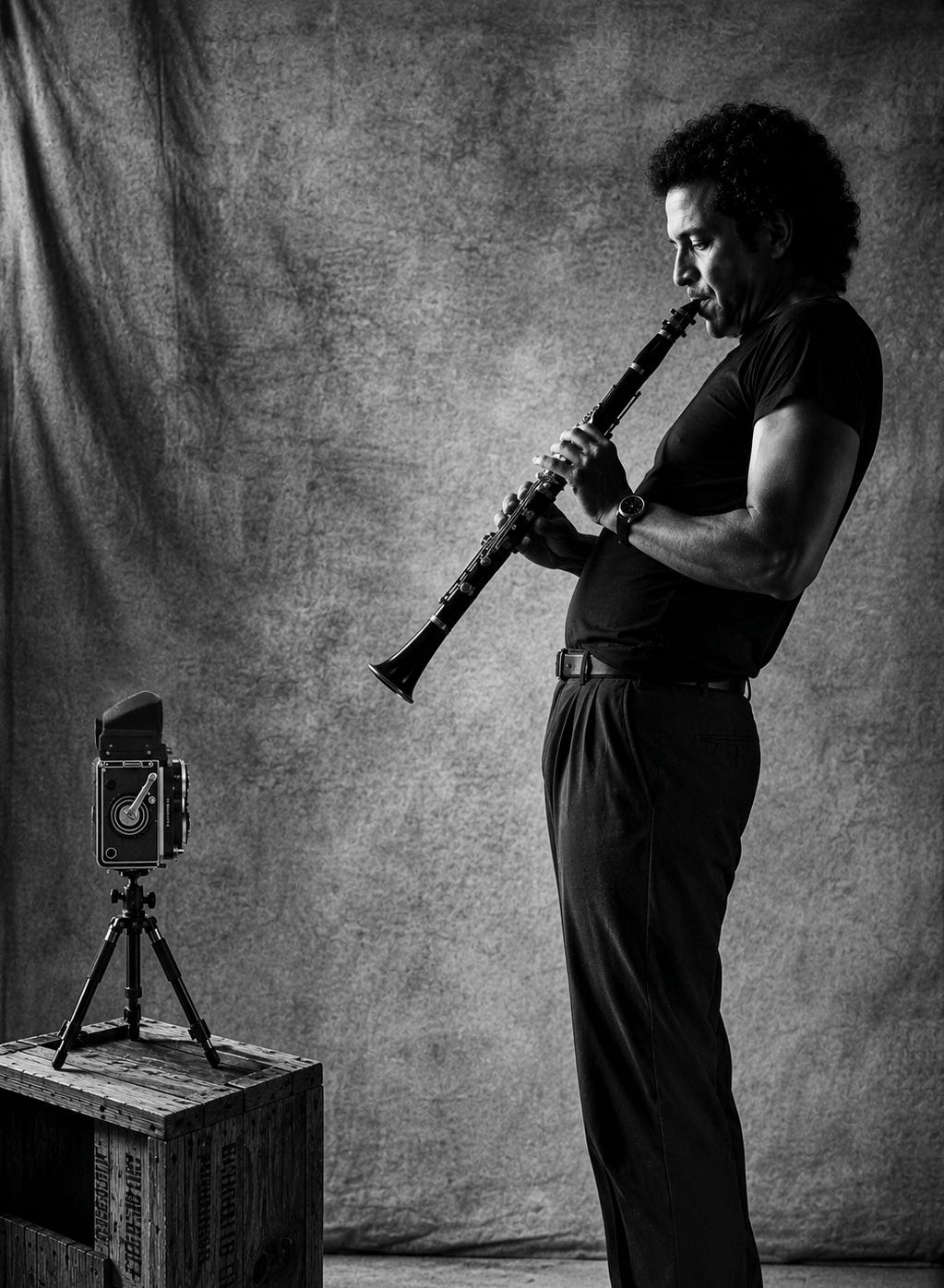
The clarinet was my first voice. Then a camera changed the composition.

Beverly Hills was the kind of place where you could find yourself standing in line at the post office behind Fred Astaire. I once did.
I was born in Los Angeles, but spent much of my childhood in Las Vegas, where my parents had moved for work when I was a toddler. Mom and Pop had already paid their parenting dues long before their accidental child came along. They worked nights. So for two years I was sent back to L.A. to board at military school. After that Dickensian detour, I was ping-ponged between Las Vegas and L.A., where I lived with one or another of my three adult siblings and their families. In 1968, Mom and Pop moved us back to Beverly Hills for good.
By then, I already had some experience with celebrities.
In Las Vegas, one summer, when I was eleven or twelve, another boy, Barry Bregman, and I were swimming at the Tropicana Hotel, probably because we had accompanied our fathers there. Pop was a violinist in the hotel orchestras on the Strip. Barry’s father, Buddy Bregman, had been head of A&R at the legendary jazz label Verve in the 1950s who was also an arranger and producer. Pop played on some of Bregman’s recording sessions with Bing Crosby in Los Angeles.
Barry lost a gold chain in the deep end. We both dove in after it. I grabbed it first and triumphantly pushed off the bottom, coming up for air like a submarine-launched ballistic missile breaking the surface. Grabbing the tiled rim and pulling myself up onto my elbows, panting, I found myself staring into the cavernous cleavage of Gina Lollobrigida, inches from my face. She was on her hands and knees, leaning over the edge of the pool, apparently concerned about how long we two boys had been holding our breath underwater. Barry and I were roundly congratulated by the poolside crowd for the attention we received from the molto famosa Italian movie star.
I didn’t see Barry again—we’d only just met at the Tropicana—until, by chance, we found ourselves reacquainted as seniors at Beverly Hills High School. He was already a budding paparazzo. His show-business family connections gave him access to celebrities, and he put his Nikon to good use selling pictures to fan magazines.
I used to visit him at home on Carmelita Avenue in Beverly Hills. We’d play records, and I’d admire his camera and lenses. The house itself wasn’t much. It was smaller than Buckingham Palace and had fewer windows than the Chrysler Building. (I’d been reading Raymond Chandler.) Given my surroundings, I started to think that maybe I should have a Nikon too.
But long before I wanted a camera, I wanted to play the violin like my father. I asked him to give me lessons. All I got was his running gag: “What’s the difference between a violin and a fiddle?” Punchline: “Lessons.” Yeah, well? None were forthcoming. He wouldn’t say why explicitly; he just fudged.
Learning to play the violin—to become a virtuoso—demanded an overwhelming commitment from teacher and student alike. He may have thought it was too hard to get to the top of the heap, and that if I didn’t turn out to be the next Jascha Heifetz, I’d be wasting his time and mine. He didn’t say so, but I’m sure he was disappointed with himself, pining over the concert-soloist career he might have pursued, instead of letting my mother drag him from Chicago to Los Angeles during the Great Depression to work in radio and movie studio orchestras. He surely would have been happier to have stayed put and joined the Chicago Symphony Orchestra like his younger brother, my Uncle Nate, who became that august ensemble’s principal bass violinist and remained so for decades. Anyway, Pop must have thought about sparing me some future heartache.
It wasn’t music lessons he was against per se, just violin lessons. When I was twelve and spending a stretch with him and my mom in the three-bedroom ranch-style house with a porte-cochere, just off the Strip, that they bought in 1956 for $12,000, Pop came home one day and presented me with a clarinet. He said it had belonged to another musician who owed him money, the spoils of a backstage card game, no doubt. I’d already turned down piano lessons, and I suppose he thought something other than a violin might pique my interest.
This particular clarinet was no world-class woodwind. But its shiny nickel-plated keys and polished black hardwood surface, the sensually smooth curve of its bell, its smell of cork grease and oil all sang to me before I blew a breath through it. Right out of its cerulean plush-lined case, as soon as I twisted its five pieces together by their cork-covered shanks, and with a desiccated reed, I gave it a go.
It would take me months to get past the squeals and honks of a tortured goose. I’m sure it took Mom and Pop a while to get past my torturing them, too. But because of the records Pop played on our hi-fi, I’d heard what a clarinet could sound like: deliciously dark, woody, and round, as though each run of notes had resonated from deep down in the bottom of an empty barrel to escape with a reverberant, acoustically pliable, and limpid bloobidy-blib-bloop-diddely-boodle-bloodle.
Soon, I was taking lessons. Over time, I would learn how to purse my lips around a hard rubber mouthpiece and use my diaphragm to push air from deep inside my lungs across a thin cane reed—like a sliver of bamboo—bound by a ligature, setting it vibrating and sending sound through an acoustically tuned bore inside a scepter of precious ebony. This is the embodiment of embouchure, a technique inherent to playing woodwinds. The word, French for mouth, is an embrace, a kiss. With this osculation, plus the dexterity of fingertips stopping holes and pressing polished keys near the top for high notes, articulated all the way down this sonorous cylinder to the chalumeau register—French for blowtorch—where the low notes live, comes an orotund timbre, a sui generis clarity of tone. Hence, to me, the name clarinet suggests a defensible association between the instrument and its tone, despite whatever other etymological antecedents there may be.
Soon, that instrument became my voice, my most reliable expression of hope and joy. Before long, I wanted to be Benny Goodman. I copied his records onto open-reel tape so I would not wear out the grooves, then learned his solos and hot licks on my own licorice stick.
When I was fifteen, my father unexpectedly picked me up after school in his black ’56 Packard with its Detroit fins and futuristic push-button transmission. I had no idea why. I’d ridden my Schwinn Continental to school, as I routinely did.
When I asked, he just said, “You’ll see.”
We put my bike in the trunk and, instead of heading home, drove the other way, toward the Strip, past hotel after hotel, getting closer and closer to where the Strip, and Las Vegas with it, abruptly ended in sand and sagebrush.
“Pop, you gonna dump my body out here?”
But the Tropicana, the southernmost and last hotel was our destination.
Pop hustled me through the parking lot and into the lobby where—drum roll, please—the King of Swing, Benny Goodman, was sitting on a sofa waiting for me.
Goodman was a certified musical legend. In the heyday of his popularity, long before I was born, this would have been like having the Beatles show up at your birthday party.
Pop had known him when they both played gigs in 1920s Chicago, before Goodman’s fame, and had apparently called in a favor. Since I couldn’t stay up late to watch Goodman perform in the Blue Room at the Tropicana, let alone ride my bicycle there, Pop drove me to his rehearsals for several more days after school.
Goodman was not simply a celebrity I happened to meet. He embodied mastery of the instrument I was trying to master myself. Watching him at close range made the life I imagined for myself seem less like fantasy. The clarinet could carry someone into another world, provided he had the talent, discipline, and nerve to follow it.
Barry’s Nikon had no such meaning for me. It was merely a status symbol.
Having parachuted in from the more conservative confines of Las Vegas, I often felt like Jed Clampett amid the “swimmin’ pools, movie stars” of The Beverly Hillbillies—except that the culture shock came not only from the wealth and glitz surrounding me but from the libertine freedoms of late-1960s California.
The object of my new desire would play second fiddle to my clarinet for a long time to come. The impulsive appeal of owning a camera was partly an attempt to look as though I belonged. I knew nothing about photography and cared more about possessing the instrument than using it. Didn’t every Beverly Hills teenager deserve a Nikon—or a Leica?
It didn’t factor into my thinking that my family lived “south of the tracks,” the vestigial streetcar rails running east and west down the middle of Santa Monica Boulevard, segregating the realm of mansions from ordinary houses, apartments, and retail shops. Yet there was more to my yearning for a camera than feeling entitled. To me, these 35mm beauties were objets d’art, coveted as much for their craftsmanship, beauty, and what they felt like to hold in my hands as for what they were designed to do. They appealed to me in much the same way as a B-flat Buffet clarinet or a resplendently brassy Selmer Mark VI alto saxophone with mother-of-pearl keys. They, too, were on my wish list, later fulfilled.
These were exquisitely manufactured instruments—the cameras, too—of sublime quality, inseparable from their utility. The combination of aesthetic appeal, mechanical intricacy, and functionality epitomized by such things occupies a sweet spot in every corpuscle of my body. The relationship between their appeal and my desire is ineffable. Still, I can at least try to explain that they have agency with me, giving me power and having power over me. It’s a feeling that has something to do with what Robert Pirsig kept trying to get at in Zen and the Art of Motorcycle Maintenance as he circled again and again around the idea of “quality” and its peculiar influence on human experience.
Have you ever held a Leica up to your ear and just listened to its intricate conspiracy of tiny gears? The sound is so inviting that using language to describe it seems impertinent. You’ll hear a soothing buzzzzzzzzzz accompanied by an equally euphonious mechanical whirrrrrrrrrr as the shutter plays out for one long second in response to an acute but quiet—shhhh!—click.
I kept practicing the clarinet for hours every day because I still intended to master it well enough either to become a jazz bandleader or to earn a chair in a major symphony orchestra. I hadn’t made up my mind yet. But you may already have guessed that this ambition would eventually be eclipsed by a camera.
It wouldn’t at first be a Nikon or a Leica, but, as chance would have it, a peculiar-looking Pentax, a 35mm SLR custom-clad in gaudy—I mean waaaay over-the-top—blood-red, scaly snakeskin.
And as if that wasn’t affected enough, I’d stolen it.
