
Blown Away By Geologic Time
Watching Geology Happen at the Speed of News

In the spring of 1980, scientists at the United States Geological Survey began voicing concern about Mount St. Helens, a long-dormant volcano northeast of Portland, Oregon, and southeast of Seattle, Washington. Considered a gem in the Cascade Range, this glacier-crowned peak rose majestically from the Gifford Pinchot National Forest. It was a vacation magnet for anglers, campers, climbers, and tourists. Locals cherished and promoted its practically trademarked immutability as the “Mount Fuji of America,” a symbol of postcard permanence. Geologists were saying it was likely to erupt.
A sequence of small earthquakes in mid-March first got their attention. Then hundreds of moderate underground explosions vented steam from the summit, precipitating the installation of sensors all around the mountain. The scientists could now report that one side of Mount St. Helens was expanding like a balloon. Earthquakes grew in frequency and strength, accompanied by avalanches of ice. When an extremely loud boom, heard more than 100 miles away in Seattle, blasted a plume of ash more than a mile high, scientific concern turned into public anxiety. The mountain was now national news. That’s when I got the call from Sygma, my photo agent, to head up there.
I flew to Portland, rented a car, and drove to a tiny town called Cougar, an idyllic community of fewer than one hundred souls, thirteen miles south of the mountain. My arrival coincided with a growing gaggle of magazine and newspaper reporters, TV crews, and other photographers who quickly overran the place. Tourists were dissuaded from showing up, or at least from staying, by a lack of accommodations. There were more press in Cougar than residents. Some of us invaders had to sleep up to twenty-five miles away in the logging towns of Ariel and Woodland. I was one of the few who arrived early enough to score a motel room. We commandeered the town’s only eatery, the Cougar Bar and Grill, with its fewer than a dozen Formica tabletops and a breakfast counter that doubled as a bar at night—our de facto headquarters and social club. Any one of us would routinely answer the proprietor’s telephone: “Cougar Press Club. Who ya lookin’ for?”
Events like this occur according to geologic time, not the media’s. Three weeks after that initial outburst of activity in March, both the mountain’s and ours, boredom set in like rigor mortis. The press corps, hoping for a climactic fireworks display, was becoming increasingly cynical about the scientists’ predictions. The insolent behavior of Mount St. Helens itself, a pinnacle of portentousness, seemed to be teasing us with mere huffing and puffing. We saw each other and ate together every day. From time to time, one of us was cajoled to make a to-go run out of town for a change of menu. At least one reporter stepped behind the stove at the “Press Club.” As for St. Helens, we began to wonder out loud among ourselves if so many incipient burps and farts weren’t merely a rude demonstration of Mother Nature’s appetite for drama, already satisfied by a flurry of media attention. Time now to go back to sleep. Nevertheless, more than once during our exasperating stakeout, I was moved by the realization of my human-scale insignificance in the presence of this behemoth, whose awesome power had squared off against civilization’s self-obsessed indifference to geologic time.
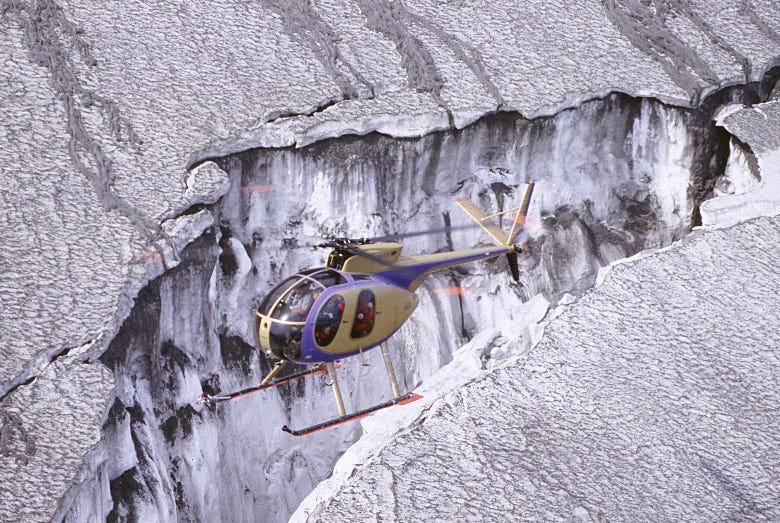
For example, a week or so into my sojourn, I hitched a helicopter ride with photographer Mark Meyer, who was on assignment for Time, to look down into the volcano’s crater. Mark brought a portable radiotelephone, a pre-cellular marvel of modern communication that weighed about two and a half pounds, not counting its auxiliary battery pack. From just shy of 10,000 feet, where supplemental oxygen would have been required, we peered out the open door into a roiling caldera belching noxious fumes. Screaming over the noise of the helo, both of us tried to describe this primeval scene in real time to Arnold Drapkin, Time’s photo editor, who was seated comfortably in a Manhattan skyscraper 3,000 miles away. It beggared one’s wits to be sitting inside this untethered machine held aloft by whirling blades pushing against molecules of air to keep us from falling into this stew pot. Our pilot was hot shit to keep us steady, so high up in that turbulent atmosphere.
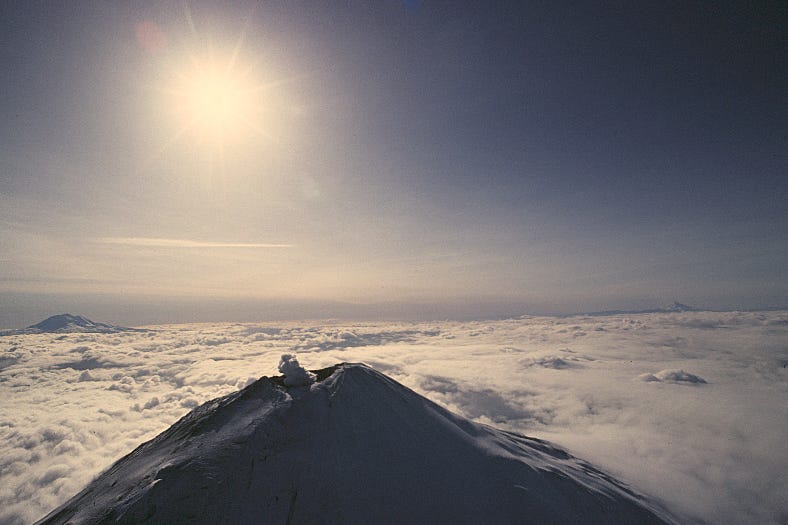
Included in this science-nonfiction scenario was a 360º Jack-and-the-Beanstalk panorama of Cascadia volcanoes, giants poking their heads through a cotton prairie of clouds that stretched boundlessly beneath a merciless blue sky. I would let my camera have the last word—or a thousand words—because I was dumbstruck trying to reconcile numinosity with technology.
Considering how my colleagues and I were kept waiting day after day for something dramatic to happen, having only minor temblors and squirts of steam to report—and for all the money it was costing—Sygma decided three weeks was long enough; I should stand down.
Unlike the production cost- and revenue-sharing covenant that agency-affiliated photographers enjoyed, able to spend more time on feature-length stories than those who got paid a “day rate” by magazines, didn’t get to stay so long, like Meyer from Time. The same goes for reporters. Journalists were coming and going almost daily, but only the wire services and regional newspapers maintained a constant presence because their reporters and photographers were employees, on salary.
On the day I was booked to fly home, I took one last helicopter ride with a U.S.G.S. team. They’d been allowing me to accompany them to the crater’s edge, landing on that most extreme of landscapes, a hellscape—but high up—utterly inhospitable to human life, to photograph them placing and retrieving instruments. Helicopter traffic was relentless, a swarm of gnats against the vast scale of St. Helens, ferrying scientists and journalists alike.
On our way back to Cougar, a short hop landed us at Spirit Lake Lodge, a fishing retreat run by an old coot named Harry—not Harry S—Truman. For weeks, officials had been trying to persuade him to evacuate, along with his dozens of cats he refused to abandon. He was too close to—no, he was on— the volcano. It was last call. But he was steadfast to be a martyr if it came to that. As I shot pictures of Harry talking to the scientists, the gods joined our chorus imploring him to leave. The earth heaved, and our helicopter, parked fifty yards away, slid discernibly in one direction while the building we stood by went the other way. Time to go! But not with Harry.
A month later, back in L.A., half-asleep on a Sunday morning, my loudly ringing bedside phone startled me upright, just past nine o’clock. It was May 18, only ten days since the launch of the Kitty Hawk. An animated Eliane Laffont, Sygma’s director, was on the line from New York, telling me to get my ass to the airport. NOW! The volcano had finally erupted, she said. She not only had me booked on a flight to Portland but would have a helicopter waiting for me on the ramp, already rotating, ready to take off the minute I arrived and stepped off the plane without entering the terminal. I was now on assignment for Time, she said. There was no time to shower or pack clothes, nor to explain to the young woman who was with me why I was suddenly abandoning her. “Just turn on the TV,” I said. “Make sure to lock up when you go.” I threw on some clothes, grabbed my camera bag plus several bricks of film from the fridge, got in my car, and sped to LAX.
The helicopter pilot made a beeline for Mount St. Helens. My plan was to land in Cougar and ...well, that was as far as I could think ahead. Real-time events dictated what would come next. We were notified in-flight by air traffic control that Cougar was unapproachable; the last leg of airspace, filled with ash, was closed. And for good reason: airborne ash is abrasive. It would have been fatal to fly through that grit, which would get sucked into the engine and cause it to seize. Our helicopter would fall from the sky, haplessly twirling like a one-and-a-half-ton sycamore seed until it slammed into the ground.
Ash also obscured the sun. The day was as dark as a moonless night. We didn’t know if Cougar, the closest settlement to the mountain, had even survived. Air-traffic control reported anecdotally that any trace of human enterprise north of town had probably been wiped off the face of the Earth. But rather than turn back, I had the pilot land in the backyard of a very surprised family’s farmhouse: “Excuse me, may I use your phone?” I don’t know how many calls I made until I got through to the commanding general of the Washington State National Guard. Invoking the name of Time magazine worked wonders; he cleared us to fly to an emergency staging area near Vancouver, about forty miles away, and land.
It was getting late now. I asked my pilot to refuel his Bell Jet Ranger and stand by, ready to fly out early next morning. I’m bad with one-off pilots’ names, be he was an early-middle-aged guy, tall, and dressed like a lumberjack. He was a Vietnam air cavalry combat veteran who said he had no compunctions about taking us as far in and as close up as we could get. In the meantime, I joined a National Guard search-and-rescue team flying a bigger UH-1 “Huey” on their final mission that evening. Mount St. Helens could not be seen above the low ceiling of a sinister sky. Returning an hour later, having found no one to rescue, I found motel rooms for the pilot and me. The day ended anxiously. I was wondering how best to cover this story.
Before dawn, I had the pilot unhinge and remove the Jet Ranger’s starboard door so I could attach an improvised harness made from seatbelt webbing, allowing me to shoot from outside the cabin with my feet planted on the skids, leaning over at a forty-five-degree angle while airborne. I learned this rig from Mischa “Mish” Hausserman, an intrepid helo pilot who flew out of Santa Monica Airport, knew every aerial angle in Southern California, and carried me on so many assignments that his is one name I can’t forget. This rig let me shoot looking down, pointing my lens either perpendicular to the ground or off to the side without seeing the rotor blades impinge at the top of my frame. An AP reporter asked to come along, even though he said I was unhinged, referring to the door. But we were happy to share the cost of chartering the Jet Ranger, hundreds of dollars per airborne hour. It would reflect well on me if my expense report showed how I saved some money, and the AP would owe me, or rather Time, a favor.
When the sun came up, the mountain was still hiding behind bad weather. But we wanted to get as close as possible, land, and then sit tight. Thus prepared, we hoped to be the first journalists within sight of the crater, and then actually on site. We would keep our eyes peeled and our ears attuned to the radio. When that carbuncle reared its head out of the murk, we would scramble into the air to survey the aftermath of its eruption and make photographs from the summit. Then we’d speed back to civilization so I could file my film.
Vulcan, Hephaestus, Pele—pick your deity—or Mother Nature had already scooped out a humungous chunk of St. Helens. But we didn’t know that yet. Nobody did. Nobody knew exactly how the mountain and its surrounding landscape had been affected by the blast. Nobody knew what even remained after the most cataclysmic explosion in North America since Lassen Peak in California blew its top sixty-five years earlier. It likewise launched a mushroom cloud fifteen miles high into the atmosphere, as sight as gruesome to behold as Oppenheimer’s Trinity atomic bomb—and rising higher into the sky. I intended to show what St. Helens looked like, post-eruption. I wasn’t thinking about showing only what remained of it.
The AP reporter would file his story, too, of course. His words would be read on the wire before my film reached New York City. Wire service photographers would see their pictures published in newspapers, too, before anybody saw mine. But I wanted to be the first to illustrate this story in living color and in Time magazine.
My gambit was risky. It almost didn’t get off the ground, so to speak, because airspace was still officially closed by the National Guard. But the fast-thinking pilot volunteered our whirlybird as an additional search-and-rescue aircraft, promising to keep our eyes out for victims and survivors. With that, we got permission to fly. With the AP reporter on board, we’d still have one extra seat available for a rescue. If we found additional survivors or victims, we’d radio their coordinates to the Guard. We were skids up at sunup, as if any sun was to be seen on another forbiddingly dark day.
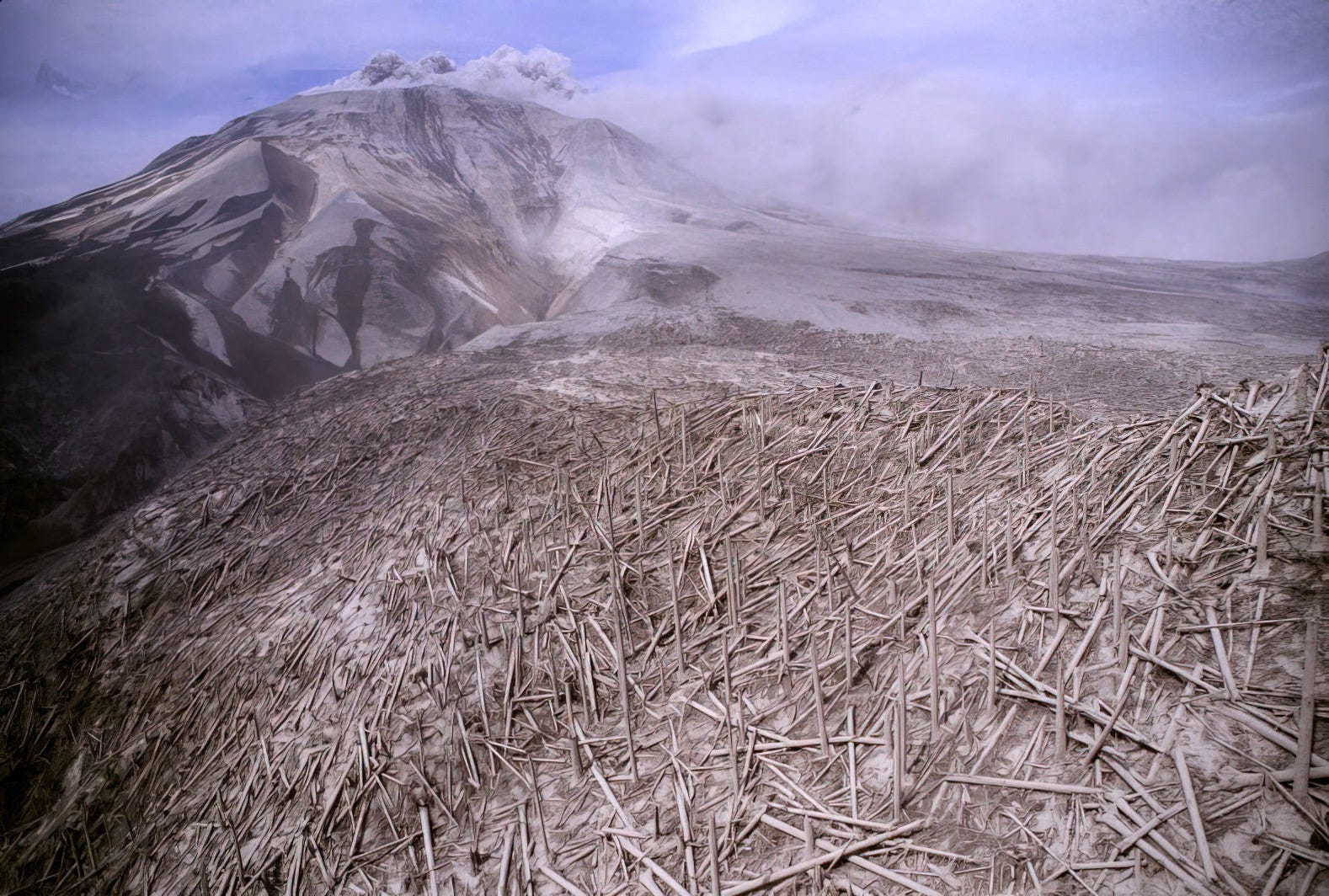
Even if the ground had not been obscured by fog, we would have been hard-pressed to recognize where we were or where we were flying to. Without landmarks, we followed our compass, scudding through the sunless haze toward St. Helens at what would have been treetop level had there been any trees left standing as we closed in on our indiscernible destination. Now and again, we caught glimpses of the surrounding desolation, including a vestigial trickle of what was once the pristine Toutle River, now choked with gray sludge, the dross of what had recently been a green forest.
Then the fog swallowed us whole. The reporter’s face, no doubt mirroring mine, was as ashen as the terrain. A tense silence gave way to the pilot’s voice sputtering through our headsets. He’d come up with a strategy to find the mountain, no less harrowing at this point than flying back to base: We’d follow the viscous Toutle upstream. Surely, it flowed down from where we wanted to be. But we could only see it intermittently. How could we trace its course?
The pilot knew. He stopped every half-minute to hover, then pitched the helicopter’s nose up with its tail aimed down to tilt the rotors to the rear and blow a hole in the fog big enough to slip through. Then he’d level off, eyeballing the muck beneath us, so close we could smell its earthy stink, and inch forward a few dozen yards before the fog closed around us again. Then we’d start all over.
We did this again and again for about fifteen or twenty minutes before the fog lifted. And there it was! What had been so lately celebrated for its loveliness was now revealed as a horrifying pustule, ruptured and gloating over a grotesque vista of its own creation. It seemed like we’d been instantly teleported to a post-apocalyptic sci-fi set on some Hollywood backlot.
Still levitating close to the ground, we corkscrewed our way up, turning and rising slowly to assess what lay outside our aluminum-and-plexiglass cocoon. Beyond our rotor wash, nothing moved. From our vantage, now at several thousand feet, there was no more gleaming glacier, no more emerald forest. There was no more Spirit Lake, no more highways, no more farms, no more animals, no more Harry Truman who had been vaporized along with his cats. From inside our helicopter, the three of us were the first to grasp the immensity of the eruption and report, over the radio, exactly how much of Mount St. Helens had simply disintegrated. Astoundingly, our altimeter indicated that the summit of this supposedly adamantine monument was 1,300 feet below what it had been the day before. What remained inside its gaping maw looked like coffee dregs in a pour-over cone filter. From that quick recon, I made the first photographs of Mount St. Helens glowering over the erstwhile woods it had laid flat like matchsticks.
Fleeing to Vancouver over felled and blackened boles, we spied the corpses of cows and deer strewn haphazardly in the slag, either asphyxiated or burned to death. Holy shit! Look, a live one. How the… ? There were no birds.
The first feedback I got from Sygma about the film I sent back was a frantic admonition. Something had gone wrong, they said. No color!
Had I screwed up? Had the lab botched the processing? Take a breath and look again, I suggested. Everything in the photos—vegetation, streets, automobiles, rooftops, billboards—was covered with a veneer of achromatic ash. Watch the skies over Manhattan, I said, if you want to see some color because that ash was blowing their way. They’d see some spectacular sunsets in a couple of days as a cloud of volcanic chaff drifted high across the continent to New York and eventually across the ocean to Paris.
I stuck around the staging area in Vancouver for several more days, joining search-and-rescue missions with the Guard. We picked up one poor fellow—lucky fellow, actually—staggering alone over the treacherous wasteland, his body encrusted with mud and ash. His name was impossible to forget: Davey Crockett. By the way, Cougar survived. The pyroclastic flow and lateral blast that obliterated so much else occurred on the north side of the volcano, opposite the town.
On another mission, I was dropped off with a squad of Guardsmen and a cadaver dog at the wreck of a cinder-covered car atop a plateau surrounded by downed trees, scorched and blown asunder. Oddly, its rubber tires looked intact, despite the car’s flambéed ossature, its paint scoured away by a 400-mph torrent of blistering-hot gas and pumice.
The Guard helo that dropped us off flew to another site, due to pick us up in an hour. Then we were informed by walkie-talkie that it would be delayed due to weather closing in. No one could say for how long.
We didn’t find any victims or survivors. But we now felt vulnerable ourselves, unnerved by an increasing regularity of small earthquakes. And every few minutes, we heard whistling sounds that emanated from all directions, growing louder and dropping in pitch— then BANG!—like incoming artillery rounds. It didn’t calm us to deduce the cause of this phenomenon: an untold number of trees, toppled by the superheated blast wave, their insides still smoldering, retained sap and water vapor enough to expand under pressure to the brink, then detonate like infernal time bombs. We were also anxious about being stranded overnight, not only in danger of succumbing to exposure but to the possibility of another eruption. We felt lucky to be picked up after a three-hour wait, just before nightfall. Then, sure enough, a day later, Mount St. Helens erupted once more, violently spewing rocks the size of automobiles and enough smoke and ash to yet again blot out the sun.
. . .
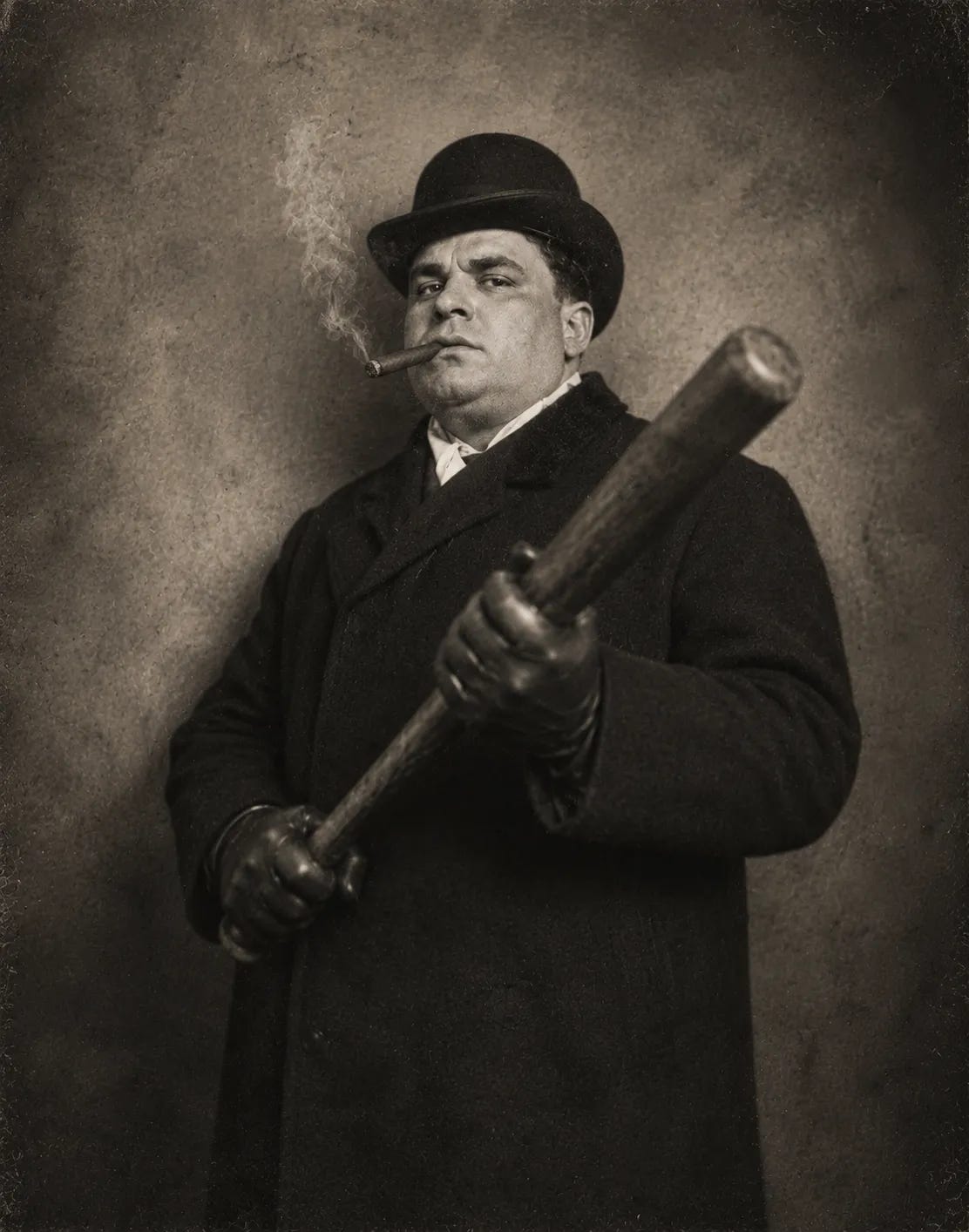
My grandfather has strong feelings about paid subscriptions.
Who needs subscription banners from The New York Times, The Atlantic, Harper’s, or The New Yorker? Who needs NPR and PBS pledge drives when you can be just as earnestly dunned for money—and made to feel faintly guilty—by A Photographic Memory?
I mean, come on. What’s more important than preserving firsthand stories from the golden age of magazines, when expense accounts were large, common sense was optional, and a ringing telephone could send a photographer anywhere from John Lennon’s living room to the inside of a nuclear submarine?
For the price of one tall latte a month, you can help keep these stories coming—and support an independent publication with no corporate parent, no tote bag, and, so far, no matching grant from viewers like you. Thank YOU.
The photographs are the way in, but the writing carries its own weight. Become a paid subscriber. The coffee will be gone in twenty minutes. The stories and the pictures, with any luck, will outlive us all.
It’s not nostalgia. It’s witness.
Coming Attractions!
Next week: from deep time to deep space. “The Force Was with Me” recounts how a photographer who knew nothing about Jedi mind tricks found himself inside the Lucasfilm universe.
TZ, what cameras were your using at Mt St Helens?
Great story. What an experience. We were just there the end of May. John
Nikons, John.
Glad you enjoyed the story. More to come!
I'd like to visit there myself one of these days. I'm sure it's all green again.