
An Absurd Proposition
Why Process Does Not Determine a Photograph's Meaning

This essay was prompted by photographer Jim Roche’s recent Substack post, “Before the Shutter,” on the relationship of black-and-white photography and artistic intention. Roche identifies a genuine problem. I think he draws the wrong conclusion from it.
If the process is chosen last, as the finish, the image is decoration.
— Jim Roche
Since joining the community of writers on Substack, I’ve read many thoughtful essays about photography by photographers whose sincerity and intelligence I don’t doubt.
That’s encouraging.
Less encouraging is a recurring tendency to draw sweeping conclusions from partial histories and technical misunderstandings, conclusions that other photographers readily accept and repeat because they sound authoritative, even scholarly, though they cannot withstand historical or technical scrutiny. Jim Roche’s recent essay is one example.
Roche has identified a genuine problem: black-and-white photography can function as borrowed authority. A weak or conventional photograph may acquire the inherited gravitas of documentary history, memory, and art merely by being converted to monochrome. A ready-made appearance can substitute for a developed way of seeing. The effect becomes the author.
But Roche attaches that problem to the wrong cause. The failure is not that the process was chosen after exposure. It is that the process was chosen without expressive necessity. He mistakes the timing of a decision for the quality of that decision and turns a useful warning against cliché into an absurd proposition: “If the process is chosen last, as the finish, the image is decoration.”
His argument also contradicts itself. Roche accepts post-capture manipulation when it clarifies tonal relationships or otherwise serves the image, yet finally condemns a process chosen after capture as decorative. The distinction he needs is not between before and after. It is between necessary and gratuitous.
Too often, present-day arguments about analog process, black-and-white photography, authenticity, and intention rest on an incomplete understanding of the techniques, practices, and working culture that shaped nineteenth- and twentieth-century photography. That matters because our conclusions about photography’s present and future are only as sound as our understanding of its past.
My vantage point is partly an accident of age and experience. I worked professionally and was published extensively worldwide through the last decades of the analog era and into the digital one, then stepped away from photography for roughly twenty years. When I returned, I had not spent those years gradually adjusting to each incremental technological and cultural change. I encountered them all at once.
I wasn’t the proverbial frog sitting in slowly warming water. I jumped back into the pot and felt the heat immediately.
That distance has made certain discontinuities easier for me to see. One is the tendency to treat post-exposure interpretation as a rupture introduced by digital photography. It was not. Photography has always involved interpretation after exposure. Darkrooms were never passive recording devices.
The world before the camera is polychrome. A black-and-white photograph translates it into monochrome. Analog photographers learned to “think” in black-and-white—to anticipate how colors would become associated shades of gray—because they had to choose color or black-and-white film before making the exposure.
Digital capture, apart from specialized cameras such as the Leica M11 Monochrom, usually preserves color information that can later be interpreted as monochrome. But that change in technical sequence does not abolish intention. It enlarges the period during which intention may be exercised.
The real issue is whether the photograph has anything to say.
A monochrome conversion cannot confer seriousness on a trivial photograph any more than Kodachrome could rescue a dull one. What matters is not whether monochrome was chosen before or after the shutter button was pressed. It is whether the photographer’s decisions serve an expressive necessity rather than merely borrow cultural authority from the history of black-and-white photography.
Intentionality resides in the work, not merely in the chronology of its production.
Roche repeatedly conflates intent, process, appearance, authenticity, and artistic value. Beneath those conflations lies a subtle essentialism: the mistaken notion that origin determines meaning.
A black-and-white photograph is “true” because of the sensor.
A photograph is authentic because of how it was captured.
It is intentional because the decision was made earlier.
It is art because process itself constitutes the argument.
I see photography almost oppositely. Meaning emerges through the relationships among subject, photographer, photograph, and viewer. Process matters, sometimes profoundly, but it possesses no moral or artistic authority merely because it came first.
I. The iPhone Moment
“There was no truth to a photo anymore.”
— Jim Roche
This is where Roche’s argument first loses ground, and loses me.
He suggests that once the iPhone allowed color photographs to be rendered in black-and-white, “there was no truth to a photo anymore.” But that conclusion does not follow.
A black-and-white conversion changes one aspect of visual representation. It does not necessarily alter the depicted event or falsify the subject matter. If I burn a print in the darkroom, dodge a face, use a higher or lower contrast paper, selenium-tone it, or crop away half the frame, have I suddenly destroyed its truth?
Of course not.
Every photograph is already an abstraction. It removes depth, movement, sound, duration, peripheral vision, and everything outside the frame. Black-and-white photography removes color. That removal may clarify, distort, sentimentalize, dramatize, or trivialize—but the fact that it occurs after exposure does not, by itself, make the photograph less truthful.
Roche’s argument quietly substitutes capture process for truth.
II. Intent Is Not Chronology
This is Roche’s central philosophical weakness.
He writes of “the process, and more importantly the intention at the moment of capture.”
Why must intention be confined to that moment?
Photography is an iterative act of seeing. A photographer may begin with one intention, discover another while working, and recognize the photograph’s fullest meaning only during editing, printing, sequencing, or even years later.
The act does not become unintentional merely because the photographer did not anticipate every final decision before releasing the shutter. That would be an impossibly narrow definition of artistic intention.
In portraiture, for example, intentionality may begin long before the sitting, change during the encounter, and become fully legible only when the photographer selects one exposure from many. The relationship between photographer and subject—not the minute at which a monochrome decision was made—is what gives the work its intentional structure.
Deciding at 2:17 p.m. rather than 2:14 p.m. does not transform intention into accident.
III. The “True Black-and-White Photograph”
Roche defines a “true black-and-white photograph” as one in which no color information was ever recorded.
That is a legitimate technical distinction. It becomes arbitrary when he turns it into a hierarchy of truth, authenticity, and intention.
His description of the Leica Monochrom compounds the problem. A black-and-white sensor is a monochrome sensor; Leica’s terminology is not “oddly misnamed.” Its photosites record light intensity without a color-filter array. Nor is this best described as “dynamic range.” Dynamic range refers to the span between the darkest and brightest reproducible values—a different technical property altogether.
The Monochrom is a fascinating camera, but it is not a moral instrument. Removing a color-filter array does not confer authenticity any more than installing one abolishes it.
A dedicated monochrome sensor and a conventional color-filter-array sensor are materially different capture systems. The former does not require demosaicing. In the latter, each photosite records a filtered sample from which full-color pixels are reconstructed. But that engineering distinction does not establish that one resulting photograph is truer, more intentional, or more artistically legitimate than the other.
Panchromatic black-and-white film was likewise sensitive across the visible spectrum, but it produced a monochrome density record rather than preserving separable color channels. The relevant historical point is not that panchromatic film recorded color information. It did not. The point is that analog photographers still controlled how the colors before the lens were translated into gray through film choice, colored filters, exposure, development, paper contrast, dodging, burning, and printing.
The tonal interpretation was always a decision.
Roche has taken a valid engineering distinction and elevated it into a standard of authenticity.
IV. Borrowed Authority
Here Roche is strongest, and here we largely agree.
Black-and-white photography carries historical and cultural associations. It can suggest seriousness, documentary authority, memory, austerity, history, or art. Those associations can be exploited lazily. A mediocre photograph may be converted to monochrome in the hope that inherited gravitas will make it appear consequential.
Sometimes the borrowed authority works.
But the susceptibility of a technique to misuse does not invalidate the technique. Sometimes black-and-white genuinely clarifies form, gesture, light, texture, or psychological presence. Sometimes it suppresses distracting color. Sometimes it sentimentalizes. Sometimes it reduces a complex world to a ready-made aesthetic.
The question is not whether the authority has been borrowed.
The question is whether the photograph earns it.
V. The Spray-can Caravaggio
Roche’s spray-can Caravaggio is a clever analogy, but it ultimately collapses.
The implication is that a visual appearance can be manufactured without the vision that originally gave it meaning. True enough. Presets, grain overlays, faded highlights, shallow depth of field, and HDR can all become substitutes for thought.
But photography has always offered techniques capable of hardening into cliché: soft-focus lenses, diffusion filters, vignetted enlargements, high-contrast printing, hand coloring, solarization, gloppy Polaroids.
No technique can supply an idea that is not there. But neither does the accessibility of a technique prevent an artist from using it intelligently.
The problem has never been technique.
It is cliché—the substitution of a recognizable effect for a reason to make the photograph.
VI. Process Chosen Last Is Not Decoration
Here is where I diverge most profoundly from Roche’s conclusion:
“If the process is chosen last, as the finish, the image is decoration.”
No.
That proposition excludes much of photographic history.
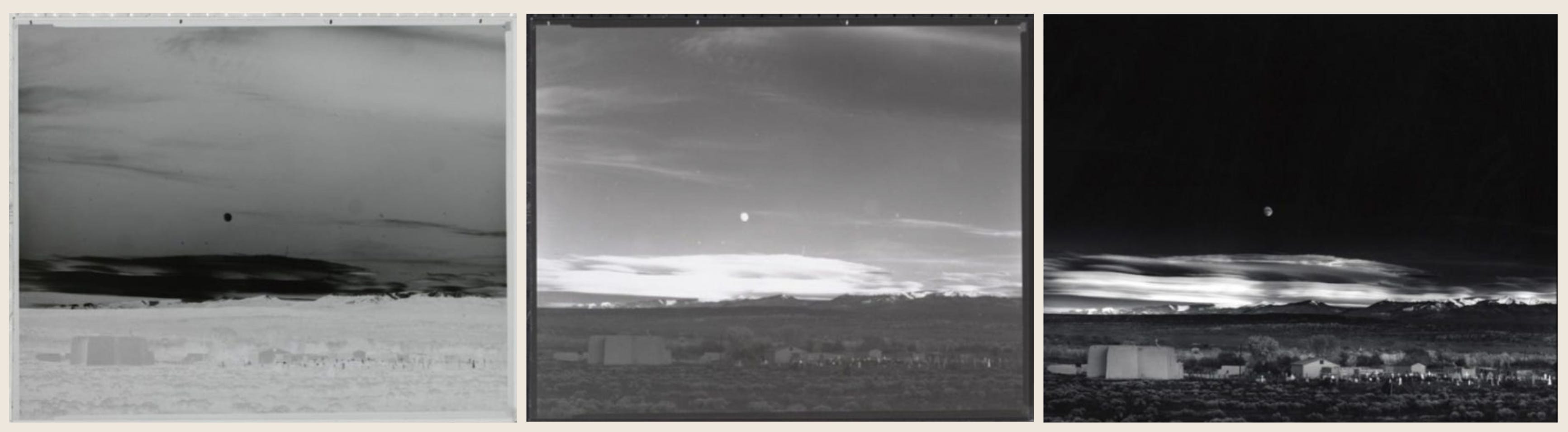
Richard Avedon made consequential editorial decisions after exposure. W. Eugene Smith reworked his prints obsessively, sometimes combining negatives and radically shaping tonal relationships. Ansel Adams described the negative as the score and the print as the performance. No two performances were exactly alike—that goes for music, too.
The photograph does not suddenly become decoration because its final interpretation occurred in the darkroom rather than before the shutter.
Nor does digital post-production represent a categorical departure from photographic practice. The tools are different, the range of control has expanded, and the opportunities for excess are greater. But deciding how a photograph should finally look—through selection, cropping, tonal control, color interpretation, retouching, sequencing, and printing—has always been part of authorship.
A process may indeed be decorative. It may be gratuitous, derivative, dishonest, or inept. But we cannot determine that merely by asking whether it was chosen before or after exposure.
We have to look at the photograph.
Photography benefits from criticism and debate. What it does not need is a new orthodoxy built upon the chronology of technical decisions.
That, ultimately, is where Roche and I part company. He places unusual weight on the origin and timing of a technical decision. I place it on the coherence of the completed work.
A photograph is not redeemed by analog provenance, condemned by digital flexibility, authenticated by a monochrome sensor, or rendered accidental because its maker continued thinking after pressing the shutter.
The image must finally stand on its own.
And it still has to have something to say.
. . .
Who needs subscription banners from The New York Times, The Atlantic, Harper’s, or The New Yorker? Who needs NPR and PBS pledge drives when you can be just as earnestly dunned for money—and made to feel faintly guilty—by A Photographic Memory?
For the price of a tall latte once a month, you can keep these stories coming and support an indy publication with no corporate parent, no tote bag, and, so far, no matching grant from viewers like you. Thank YOU.
The photographs are the way in, but the writing carries its own weight. Become a paid subscriber. The coffee will be gone in twenty minutes. The stories and the pictures, with any luck, will outlive us all.
It’s not nostalgia. It’s witness.